
Why Is the Brain the Biggest Sexual Organ?
The Brain is the Most Important Sexual Organ
Often when we think about sex, we consider genital function. How hard is my erection, how wet is my vagina? How can I “perform” better?
What we miss in this line of thinking is that our brain, not our genitals is the most important sexual organ in our experience of sexuality. We have sex with our brains, not only our genitals. Pleasurable sex is a whole body, and whole brain experience.
Prefer to listen?: Why is the brain the biggest and most important sexual organ? This podcast explores the role of the brain in sexual wellbeing.
So why is it that the brain is THE MOST important sexual organ?
Sexual interpretation: it is the brain that determines and interprets whether a touch, scent, sound, sight, smell, taste is a sexual stimulus. A situation is evaluated as erotic or not by the brain, utilising values, beliefs, and past experiences that have shaped us. Without the brain interpreting signals, signals just remain signals, not sexual cues.
The brain controls arousal: when the brain interprets a signal as sexual it sends signals to the body to “turn on” arousal. The brain is also constantly scanning for potential threats that signal danger, or any reason that sex might not be appropriate right now. If the brain picks up on a signal and interprets it as a threat, it sends signals to the body to “turn off” arousal. When the brain is picking up “on” signals, and “off” signals are dialled down or absent, full brain and bodily arousal can occur. While the brain is largely responsible for “turning on” arousal, genital arousal can occur as an involuntary reflex response to genital stimulation. In this context, the brain still needs to determine whether this is a wanted, unwanted, or pleasurable situation. If interpreted as a threat, the brain will attempt to switch arousal off, although the body may still respond if genital stimulation persists. This highlights again why the brain is so important in arousal. The brain determines the experience of subjective arousal, if a sexual stimulus is subjectively pleasurable and wanted to that individual. This experience of subjective arousal is more important to sexual wellbeing than genital response alone. (Read more on arousal here)
The brain generates arousal: not only does the brain control arousal by responding to external signals, the brain itself can generate arousal without any external signals. This is arousal generated purely from sexual thoughts, fantasies, memories and emotions. The arousal generated from the brain can be strong enough to fuel arousal throughout the body, leading to orgasm from thought alone. An example of this are orgasms that are experienced during sleep, due to sexual dreams that are autonomously generated by the brain. (Read more on arousal here) There are also instances where genital arousal is experienced during the Rapid Eye Movement (REM) sleep cycle, without any sexual dreams. This happens during REM to support healthy blood flow to the genitals.
The brain is the chemical factory of desire: The emotional brain and pleasure centre (the limbic system) releases chemicals that drive sexual behaviour. (Read more on the chemicals at play in sexuality here) Desire is the motivation or interest in sexual activity in anticipation of pleasure, or in response to pleasure. The brains role again is critical here in determining what is pleasurable or not. If the brain determines a sexual cue is pleasurable it floods your nervous system with dopamine, which amplifies sexual motivation. (Read more on desire here)
Orgasm starts in the brain: Orgasm is the release of sexual tension. The brain must receive enough sexual stimulation and signals to reach a threshold of release. The brain is involved in intensifying sexual stimuli and releasing pleasure chemicals. Once the brain reaches a “tipping point”, it is this sudden transition that is the onset of an orgasm. While the physical sensation of orgasm is felt in the genitals, it is the brain that gives this meaning. It is the brain that creates the feeling of pleasure.
The brain gives sex meaning: sex in humans transcends purely biological functioning, and has deep psychological and emotional meaning due to the brain. The neocortex gives us the capacity for self-awareness, language, and imparting meaning to behaviours. The neocortex is also why humans have the capacity and need for emotional connection, the desire to share our hopes, fears, vulnerabilities and ultimately who we are. In romantic relationships, emotional safety is often a cue for physical arousal. The neocortex also gives us the capacity for sexual fantasy, which alone can generate such strong arousal to the point of orgasm.
Core values, beliefs, and sexual messaging is stored in the brain, permitting us to surrender to sexual pleasure or to shut down. Past memories are also stored in the brain, and these are referenced to inform how to feel in the present. A history of pleasurable sexual encounters informs the brain to anticipate future pleasurable intimacy. Whereas, a history of difficult sexual encounters primes the brain to see sex as a threat. Long before we even engage in sex, our brains have a template for romantic relationships based on the nurture we experienced with our earliest caregivers. This profoundly shapes how romantic and sexual love is experienced in adulthood.
Given the brain’s meaning making power, context is absolutely everything when it comes to desire and pleasure. Context may be external, such as the setting, who you are with, and relationship dynamics. Context is also internal, whether you are stressed, exhausted, or relaxed. The same sexy comment in one context may be experienced as a turn on, and a complete turn off in another. When the context is safe and pleasurable, this gives way for sexual arousal, whereas if the context is tense, stressed, unpleasant, often this hits the brakes on arousal. Context is highly subjective, and what is pleasurable or unpleasant for one, varies for another.
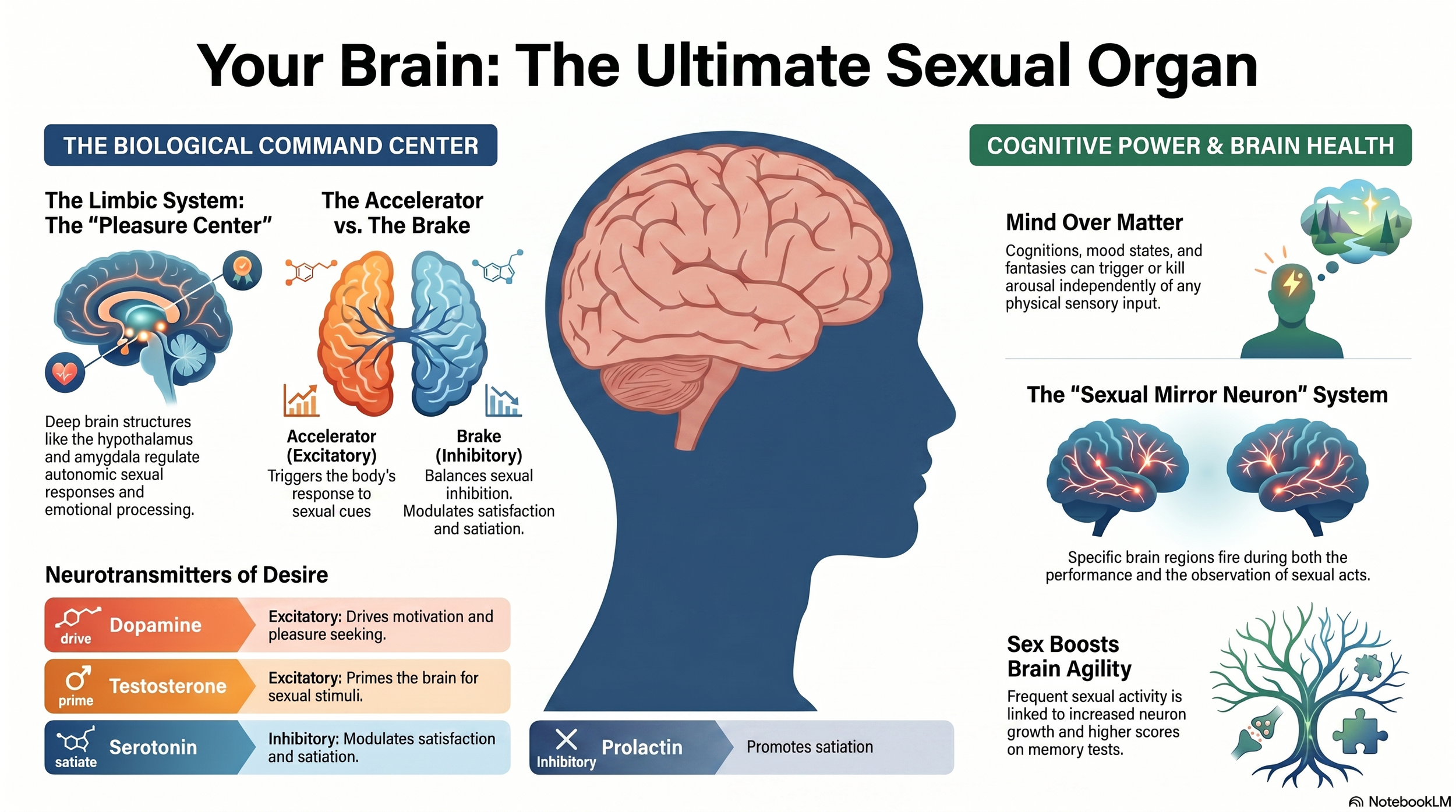
The brain is the biggest and most important sexual organ. You have sex with your brain, not only your genitals.
Myths About the Brain and Sexuality
Myth 1: Sex is mostly about the genitals
The genitals are a great source of pleasure, but without the brain to interpret the touch as pleasurable, it’s just friction. Genital health and function, of course is important to nurture, but when this is limited, it is the brain that allows for an expansive experience of sex.
Myth 2: If my body responds, I must want sex
Touch to the genitals can be physically arousing due to the spinal reflex response that occurs. However, subjective mental arousal is a critical component in full arousal, pleasure, and consent. Just because the body is responding, does not mean the mind is aroused. The brain may also send signals to shut off arousal, but this can be diminished by the strong arousal reflex.
Likewise, the brain can play a powerful role in physical arousal. Sometimes the absence of physical arousal is reflective of the mind’s disinterest in sex at that moment. Whereas physical arousal can flow on from mental arousal. Other times the brain may be aroused, but the body’s arousal does not activate strongly. As you can see, it is not always so simple as a + b= c
Myth 3: Attraction alone should create arousal
Both mental and physical arousal is key to create full arousal. This is particularly true with age. With age, while mental arousal is critical, the stimulation of the body and genitals is increasingly important to enhance physical arousal. Remember, there are also so many factors at play contributing to context such as personal history, beliefs, and values that may over power the mental arousal that comes from attraction alone.
Myth 4: Sexual difficulties are purely physical
If this were true, life would certainly be easier in some ways. Take a pill, have a surgery- you will be fixed! Sexual difficulties are complex because they often involve the interplay between biology, psychology, relational, behavioural, and even societal factors. Even when a sexual difficulty stems from a physical origin (such as diabetes, high cholesterol) there will be psychological impacts that can either help or hinder sexual function. The most immediate impact on sexual functioning is the psychological process of performance anxiety which shuts down the arousal response.
What does this mean for me sexually?
- Explore your values and beliefs around sex, unpack how these developed
- What turns you on or off, and in what specific context?
- What does sex mean to you and why?
- How is stress impacting your mental and physical wellbeing?
- What “ingredients” lead to the most arousing sexual experience? Why?
- When in your relationship do you experience the most sexual desire?
- Remember: We have sex with our brains, not only our genitals.
How Sex Therapy Can Help
If the brain is the most important sexual organ, it makes sense that many sexual difficulties cannot be fully understood through a purely physical lens.
Sex therapy takes a holistic approach to sexual wellbeing by exploring the biological, psychological, relational, behavioural, and social factors that influence sexuality. Together, we explore how your unique experiences, beliefs, values, relationship dynamics, emotional wellbeing, and physical health shape your sexual experience.
In therapy, we may explore:
- the beliefs and messages you have learned about sex
- the factors that activate your sexual “accelerators” and “brakes”
- how stress, anxiety, shame, trauma, or performance pressure impact arousal
- communication and emotional intimacy within relationships
- practical strategies to enhance desire, arousal, pleasure, and connection
The goal is not simply to improve sexual function, but to enhance overall sexual wellbeing. By better understanding how your brain influences your sexual experiences, you can begin to work with your sexuality rather than against it.
I offer online sex therapy across Australia, supporting individuals and couples experiencing difficulties with desire, arousal, orgasm, sexual pain, relationship intimacy, and sexual wellbeing.
Written by Justine
References:
Gambescia N, Weeks GR, Hertlein KM. A Clinician's Guide to Systemic Sex Therapy. 3rd ed. New York, NY: Routledge; 2021
Lew-Starowicz M, Giraldi A, Krüger THC, editors. Psychiatry and Sexual Medicine: A Comprehensive Guide for Clinical Practitioners. Cham: Springer Nature Switzerland AG; 2021
Gunasekaran K, Khan SD, editors. Sexual Medicine: Principles and Practice. Singapore: Springer Nature Singapore Pte Ltd; 2019
Lehmiller JJ. The Psychology of Human Sexuality. 3rd ed. Hoboken, NJ: John Wiley & Sons Ltd; 2024
