
Why Doesn’t Sex Feel Exciting Anymore?
The answer may not be found in the bedroom as you might initially suspect! The ability to experience excitement in life is critical not only for overall wellbeing, but also has an essential role to play in sexual wellbeing. When it comes to sexual wellbeing, excitement contributes to desire and arousal.
Prefer to listen? This podcast episode answers the question: why doesn’t sex feel exciting anymore?
To understand how excitement contributes to desire and arousal, let’s break down what desire and arousal mean.
Desire and arousal are distinct but deeply connected and inseparable components in sexual functioning.
Desire= the mental interest in sexual activity as the anticipation of sexual pleasure or the response to sexual pleasure
Arousal= the pleasurable experience of mental and physical excitement for sexual activity
Arousal; both the physical and mental experience of sexual excitement is not always limited to excitement by sexual cues. Arousal can come from the relationship itself, from being attracted to your partner not only physically, but as a person to be excited by. Arousal can come from touch that is pleasurable, enjoyable, stimulating and erotic. It is important to remember that subjective mental and physical arousal is key, meaning that it is the person receiving the touch that decides whether the touch is enjoyable or not.
What is the Relationship Between Desire and Arousal?
Sometimes desire comes before arousal.
Desire comes before arousal, when someone is anticipating and thinking about sexual pleasure. In this process of thinking about sex as pleasurable, and then possibly also acting sexually from these thoughts, the mind and body becomes excited (or aroused) to engage in sexual activity. This might look like, “I’m thinking about how good it would feel to be sexual with you, so I want to have sex with you, and now that I’m thinking about it more, I’m starting to feel turned on”.
Sometimes desire follows arousal.
Desire can follow arousal when there is pleasurable mental and physical excitement that is already present. For example, being excited by seeing your partner in their zone, after having a night filled with laughter, kissing each other passionately, enjoying a sensual back rub. When this pleasurable mental and physical excitement occurs, then interest in sexual activity occurs. This might look like, “I’m really enjoying the way you’re kissing me, this is turning me on, now I’m thinking about how good it would feel to be sexual with you.”
Arousal is absolutely critical to desire, especially in the experience of responsive desire, where desire follows arousal. Arousal feels pleasurable, and if desire can respond to pleasure, we need to amplify pleasure. One way to amplify pleasure is to specifically amplify the excitement in arousal.
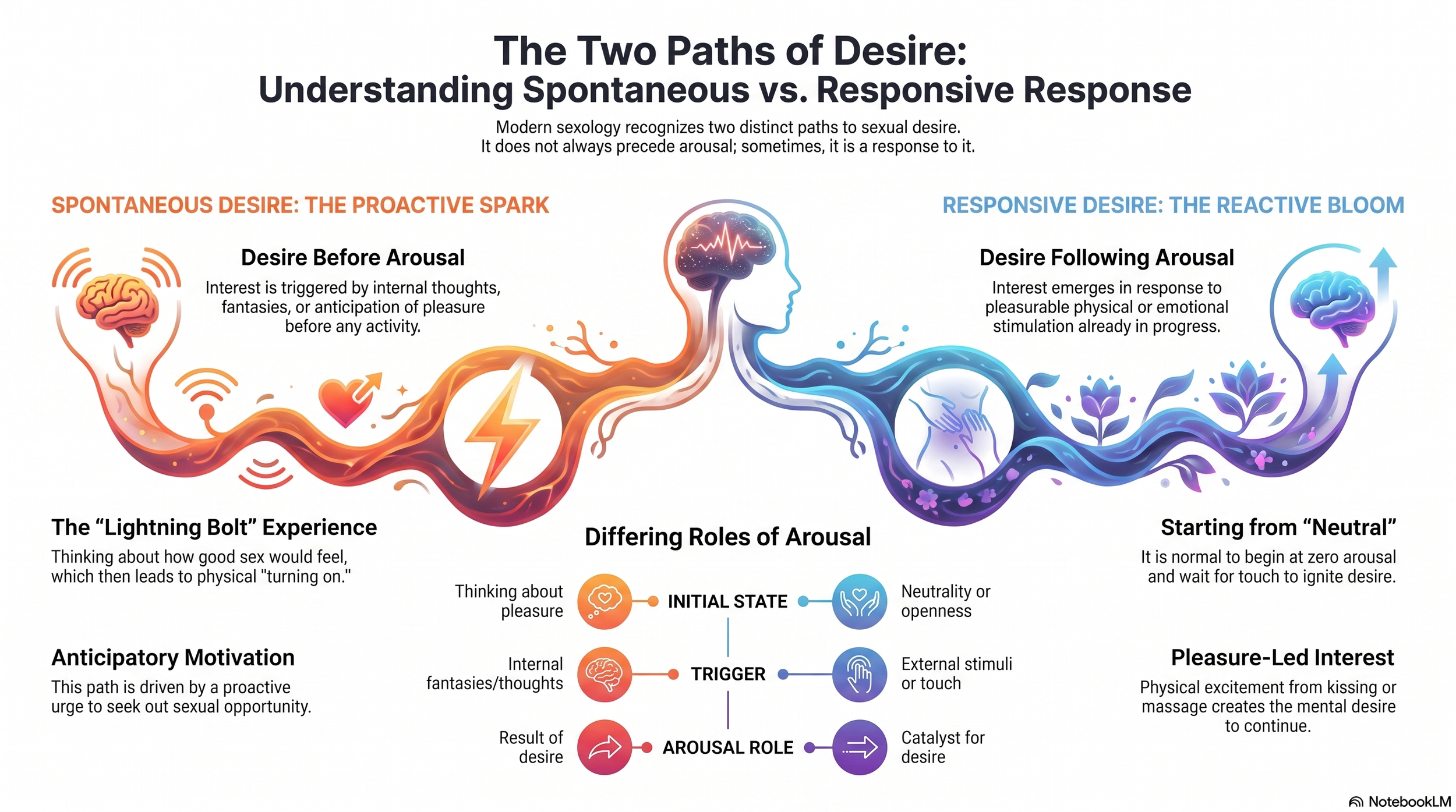
Understanding Spontaneous and Responsive Desire
How does excitement apply to sexual arousal?
A significant barrier to sexual arousal, may be that excitement is diminished more broadly in your life. This might be true if you are feeling cramped or even suffocated by daily stressors, anxiety, or depression. Maybe you feel lost in yourself, disconnected in the relationship, and this overall sense of missing excitement then translates to the bedroom as being unaroused by sex. For others, this lack of excitement in general life may then put unrealistic pressure on sex to be their “saving” or “rescuing” source of excitement. Sex is treated as the sole form of escapism from the blandness of everyday life. This unrealistic pressure on sex can amplify the urge towards sex, leading to greater frustration and disappointment when sex falls short of this impossible standard. This pressure on sex can also be felt by a partner as demanding, which inherently drains excitement for them. The answer for both scenarios is to cultivate excitement in multiple domains of life and within your overall relationship.
With this focus on amplifying excitement, it is important to consider:
When was the last time you felt excited by your partner?
When was the last time you felt excitement for your partner?
When was the last time you did something exciting?
When was the last time you felt genuinely excited?
How do you cultivate a life of excitement?
How do you cultivate a relationship with excitement?
How does my personal wellbeing impact sexual intimacy?
Excitement is not something we sustain 100% of the time…because that is just not sustainable or realistic to our lived experience of humanity. However, it is an important ingredient in our overall wellbeing, and including in our sexual intimacy. It might be possible if you are lacking in excitement generally and individually, that it is difficult to generate and build excitement together in your relationship, and also within sexual activity. Sometimes, the first steps towards greater sexual wellbeing, is actually your personal wellbeing. Sexual excitement may flow from intentionally cultivating excitement and pleasure in your daily life, then your relationship, and then in the bedroom.
What if it’s the sex that is not exciting?
There are of course times, where your answer may be- my life is exciting, my partner does excite me, but I cannot seem to find that excitement in sexual activity. If this is the case, it is important to first understand what is hitting the brakes on sexual arousal (read more about this concept here). Is it stress, is it the meaning of sex (has sex become a chore, a duty, an obligation, a pressure?), is it general exhaustion, negative past experiences of sex, negative beliefs around sex…does sex simply feel routine or boring? The list can be so varied and unique as to what inhibits arousal for individuals. These must be understood and actively addressed, for arousal to then have the freedom to emerge. These constraints suffocate excitement.
What does exciting sex look like?
Exciting sex is sex that is pleasurable…and what is pleasureable depends on the individuals consenting to the sexual relationship! I want to make it very clear that sexual excitement is not necessarily about a new toy, a new position, new lingerie, a new location- although these may be things that people do find pleasureable, exciting and want to explore. Exciting sex can also be the pleasure found in deeply meaningful, intimate, loving, slow, and sensual sexual activity. The question is, are you experiencing the type of pleasureable sex that you want to experience? If not, what is getting in the way of this?
How Sex Therapy Can Help
Sex therapy can help you understand what creates excitement in your unique sexual relationship, and perhaps more importantly, what diminishes it.
Together, we explore the biological, psychological, relational, behavioural, and social factors that shape your experience of desire and arousal. This includes identifying what activates your sexual "accelerators" and what applies the "brakes" to excitement. We also explore the meaning that sex has come to hold within your relationship. Has sex become associated with pressure, obligation, performance, conflict, or disappointment? Or does it remain a place of curiosity, pleasure, connection, and playfulness?
Sometimes the work is about introducing more novelty and excitement into sexual intimacy itself. Other times, it is about rebuilding excitement in the relationship or in your own life more broadly. Sexual excitement rarely exists in isolation. It is often nurtured by the overall quality of our wellbeing, relationships, and the lives we are living.
I offer online sex therapy across Australia, supporting individuals and couples experiencing difficulties with desire, arousal, intimacy, and sexual wellbeing.
