
Can Anxiety Affect Sexual Arousal?
The relationship between anxiety and sexual arousal are not as simple as they first appear. At times anxiety can be an instant mood killer, suffocating arousal. Other times, anxiety can even fuel and enhance arousal. This article explains why.
To understand the relationship between anxiety and sexual arousal, we need to explore how they show up in the body.
The physical sensations of anxiety and sexual arousal in the body are exactly the same.
Can anxiety affect sexual arousal? If you’d prefer to listen rather than read, my podcast explores the answer to this question.
What are the physical sensations of anxiety?
- Racing heart
- Shallow breathing
- Blood pumping
- Sweat
- Increased muscle tension
What are the physical sensations of sexual arousal?
The answer is- exactly the same! Both anxiety and arousal also share in the release of adrenaline which gives the body a burst of energy resulting in the racing heart and muscle tension.
While the physical sensations are exactly the same, one feels exciting, and the other can feel fear inducing.
If the physical sensations are the same, how does the brain differentiate the “feeling” of anxiety from sexual arousal? A key difference is that while the physical sensations are identical and both share in the release of adrenaline, anxiety also releases cortisol, known as the stress hormone.
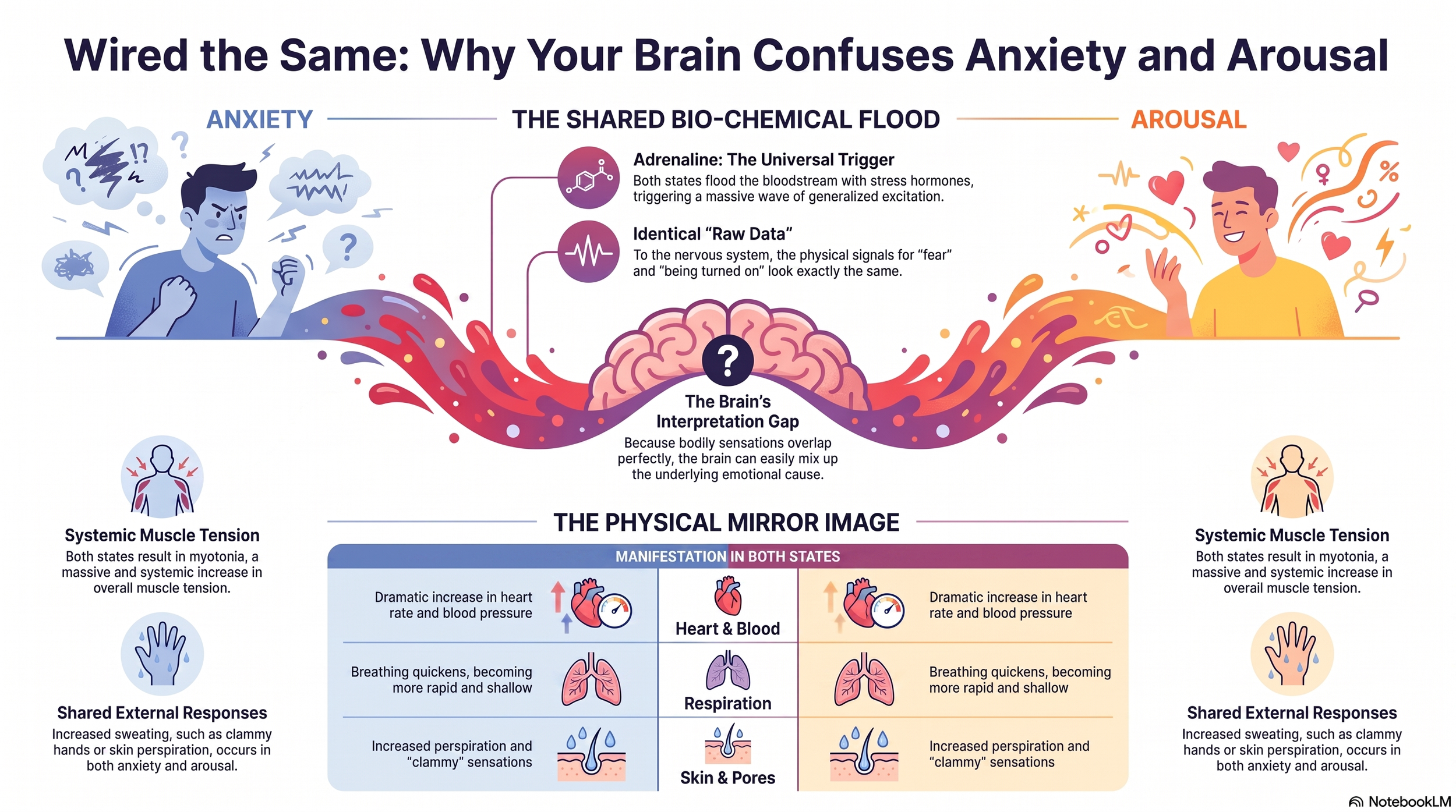
Anxiety and Arousal: Shared Physical Sensations
The brain also interprets the physical sensations based on meaning and context. Here’s how it plays out.
How does the brain determine whether to feel sexually aroused or anxious?
Step 1: The Cue
First there is a cue which could be internal or external. Internal could be a thought, fantasy, emotion, or physical sensations (such as the physical sensation of anxiety or arousal). External cues could be a sight, something that you hear, physical touch, or even a smell.
This cue is then processed by the emotional centre of the brain, and then the thinking centre of the brain.
The emotional centre: Unconscious Meaning-Making
Step 2: Survival-First Processing
The brain operates survival-first, it is always trying to keep us alive and safe from threat. Before we are even consciously aware, our brain’s threat detection system has lightning-fast evaluated the cue.
Deep in the brain’s emotional centre, the brain is always scanning for immediate threats. This is an unconscious, and automatic process. If the brain’s threat system is activated the typical response is to generate anxiety. When the brain’s threat system is activated, cortisol and adrenaline are released. While adrenaline is also present in sexual arousal, cortisol is a long-acting stress hormone which traps the body in its state of high alert, prioritising survival and generally shutting down the relaxation required for genital response.
How the body responds to adrenaline also matters. While present in arousal, adrenaline paradoxically plays a role in constricting the genitals. In sexual arousal, adrenaline provides that sense of excitement, however, blood must be allowed to flow into the genitals. Therefore, the brain must simultaneously send signals to the nerves in the genitals to open up, and allow for blood to flow in. In anxiety the brain does not send these “on” signals to the genitals, allowing adrenaline to constrict genital blood vessels, keeping blood away from the genitals. This explains experiences such as a lack of genital pleasure or a loss of erection, when there is the experience of performance anxiety.
Step 3: Emotional Processing
Next the cue is processed in the brain’s emotional centre’s “One Ring”. The “One Ring” of the brain acts as a master switchboard, managing all emotional experiences. Three specific functions differentiate emotional experiences: learning, liking, and wanting. The learning function is based on past experiences and learned associations. The brain has linked certain cues with sexual pleasure, and other cues with fear.
The liking function assesses does this feel good or bad? In a safe context, where the threat system has not been activated, the elevated heart rate is registered as pleasant. The wanting function is the accelerator of the emotional brain, driving motivation to behave or act accordingly to the emotion. If the brain perceives threat, the learning system associates with fear, which the liking system registers as unpleasant, the wanting system motivates avoidance or escape. If the brain perceives no threat, the learning system associates with sexual pleasure, which the liking system registers as pleasant, the wanting system motivates the pursuit of stimulation.
Next the cue is processed by the thinking brain.
The thinking brain: Conscious Meaning-Making
Step 4: Thoughts and Interpretation
The thinking part of the brain consciously evaluates the situation.
What happens if the brain has determined you are safe?
If the thinking brain detects a cue that it determines to be sexually relevant, and the threat system is quiet, sexual meaning is then assigned to the physical cues. Rather than anxiety, the brain says, “this is sexually exciting!”
What happens if the brain has determined you are being threatened?
Alternatively, if the threat system has been activated and the "One Ring" is motivating avoidance, the thinking brain attempts to make sense of the intense physical tension. Instead of assigning sexual meaning, it assigns an anxious meaning to your racing heart (e.g., "I am going to fail" or "this hurts").
The thinking brain shifts into frantic problem-solving or "spectatoring” (pulling you out of your body into a “watching yourself” mode) which guarantees that arousal cannot take hold.
Context is highly involved in the brain’s ability to both unconsciously and consciously make meaning out of a situation. For example, the beating heart after a romantic dinner with a partner could be perceived as highly arousing, whereas alone in a dark alleyway, perceived as fear.
While anxiety is often thought of as an arousal killer, the reality is that the relationship between anxiety and sexual arousal can be far more complex.
Given the overlap between physical sensations of anxiety and sexual arousal, the two can sometimes get tangled up and confused, and anxiety can even act as a fuel for arousal.
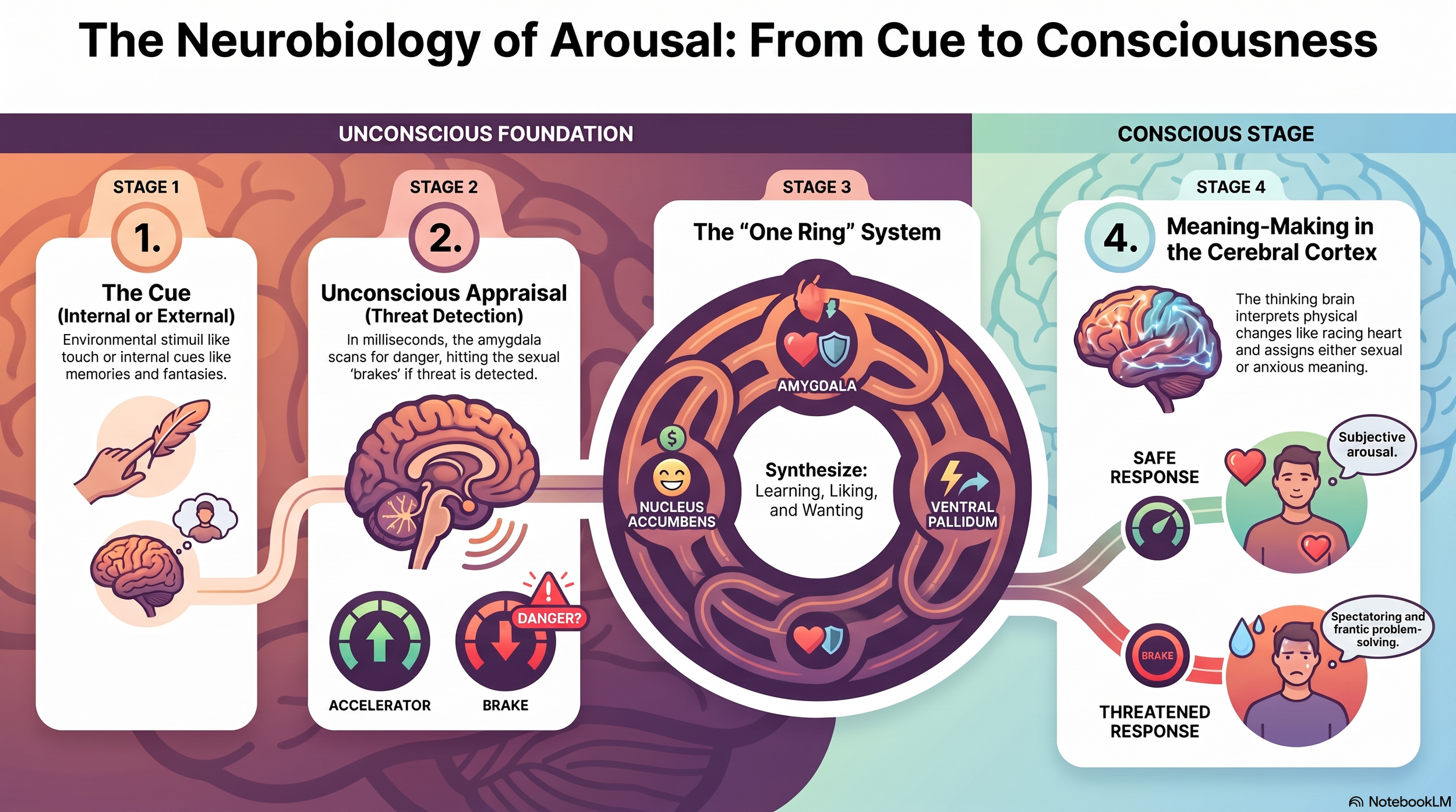
How the brain determines if a cue is sexual or a threat
The Misattribution of Arousal and Excitation Transfer.
If there is ambiguity about the meaning of a cue, or there is a strong sexual cue in the midst of an anxious situation, the brain can misattribute anxiety as sexual arousal or determine the cue as sexual. Rather than feeling anxious, a person may feel aroused instead. This is known as the misattribution of arousal. An example of this is the “bridge study” where men walked across a swaying suspension bridge which induced physical symptoms such as a racing heart, but there was an attractive female researcher at the end of the bridge. The men misattributed their racing hearts as sexual arousal rather than fear.
Excitation transfer refers to how the body takes the brains misattribution and uses the anxious energy to physically fuel sexual arousal. The physical arousal of anxiety such as shallow breathing transfers directly into sexual arousal, which is easy for the body to do due to the shared physical symptoms. As there is already physical arousal in the form of anxiety, the transfer to sexual arousal feels even more intense than if the sexual arousal had emerged from a neutral or calm baseline.
Excitation transfer does not only happen for anxiety, but can also happen for other states of physical arousal. For example the heightened physical arousal after physical activity, can be transferred to heightened sexual arousal. During periods of amplified stress, the nervous system is highly activated. A person may seek orgasm to release the built-up tension, and over time, the brain learns to co-opt this stress energy so efficiently that they exclusively develop heightened sexual interest during intense personal stress. Excitation transfer can also explain why sexual arousal can peak when there is an element of risk or taboo. While there may be negative moods such as guilt or fear, excitation transfer rapidly converts this into sexual fuel and the experience of liberation, thrill, celebration, and passion.
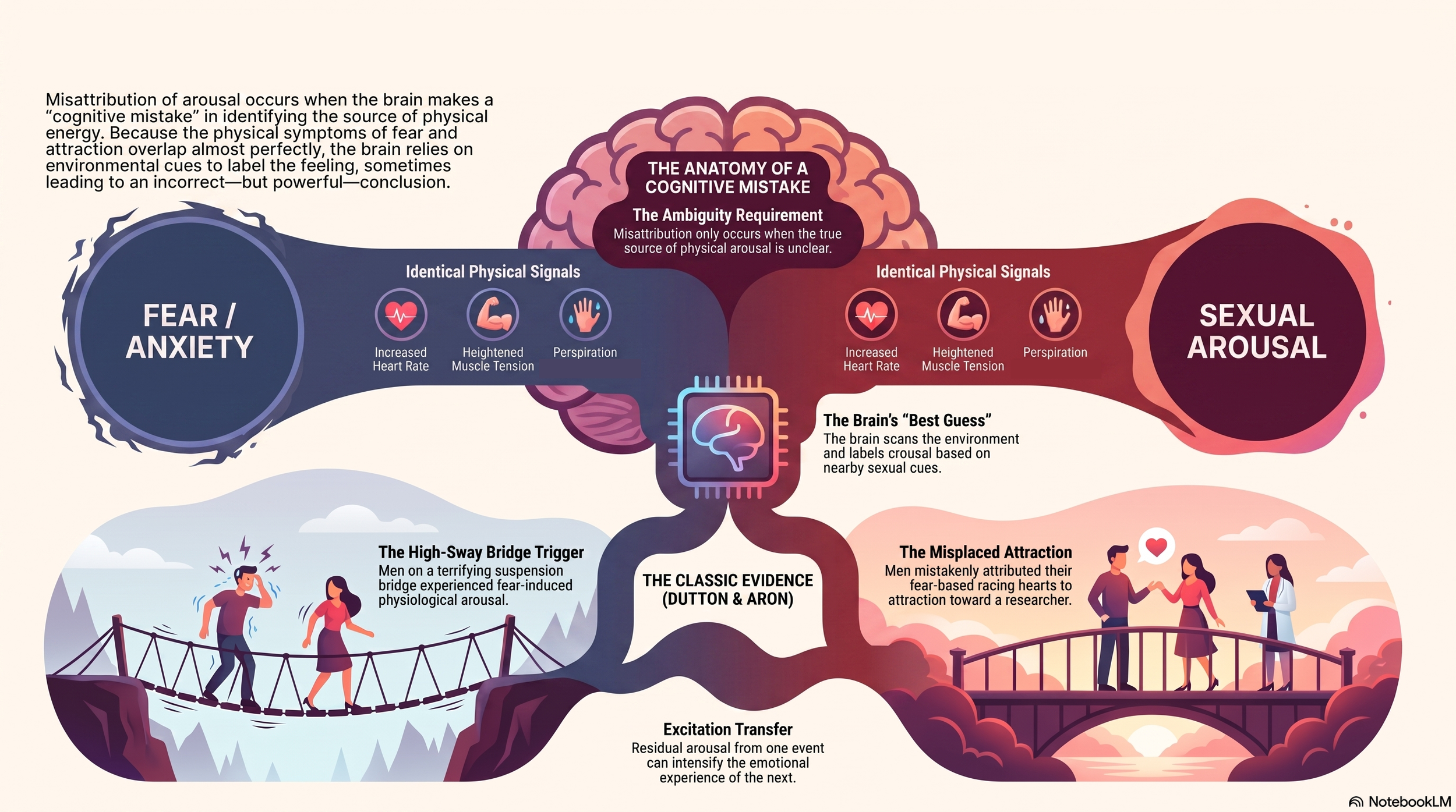
The misattribution of arousal and excitation transfer
The Timing of Anxiety Matters
When anxiety emerges also tends to make a difference to the experience of sexual arousal.
If anxiety is present before a sexual cue, the anxiety and the cortisol released acts as a sexual brake, diverting blood away from the genitals. For example, feeling worried about sexual performance or sexual pain before even starting sexual activity, can actively suppress sexual arousal.
If anxiety emerges suddenly during sexual arousal or sexual intimacy, this can also act as a sexual brake. For example, during sexual activity, if you suddenly find yourself distracted by work worries, this is likely to diminish sexual arousal.
When anxiety is present at the same time as emerging sexual arousal, this is where the two forms of physical arousal can play off each other and heighten sexual arousal. For example, a couple sneaking off during a busy family holiday, hoping not to get caught (anxiety) but also feeling arousal for each other. The resulting arousal feels even more exciting and intense. This is another example of excitation transfer.
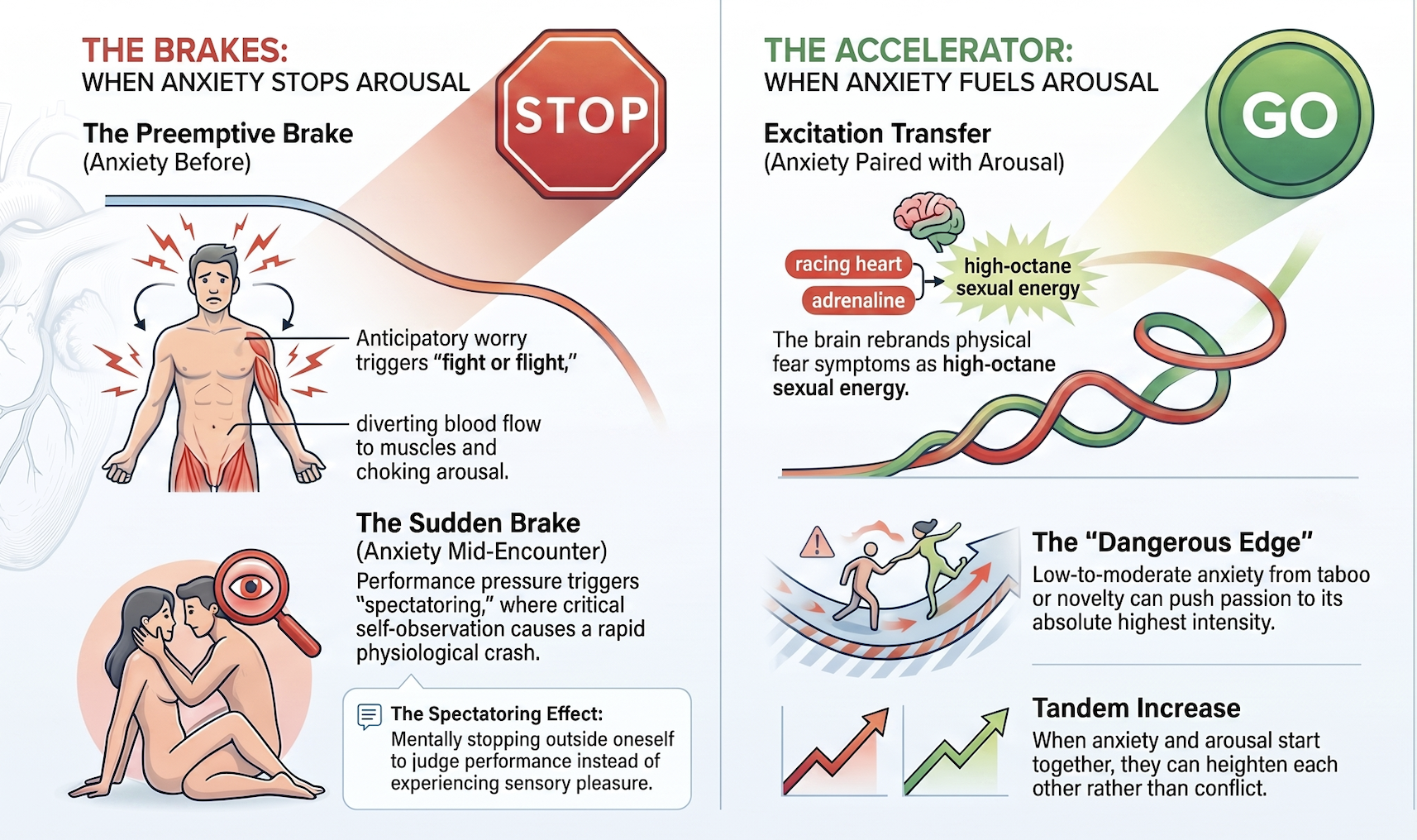
How the timing of anxiety impacts sexual arousal
The Intensity of Anxiety Matters
The intensity of anxiety also makes a difference to the experience of sexual arousal.
Low to moderate anxiety, when paired with sexual arousal tends to amplify the experience of sexual arousal. Whereas severe anxiety tends to shut down arousal completely, constricting the genitals and drawing blood away.
It is crucial to understand that while this is a typical response, there is the paradox of arousal nonconcordance where genital responsiveness occurs even without mental arousal.
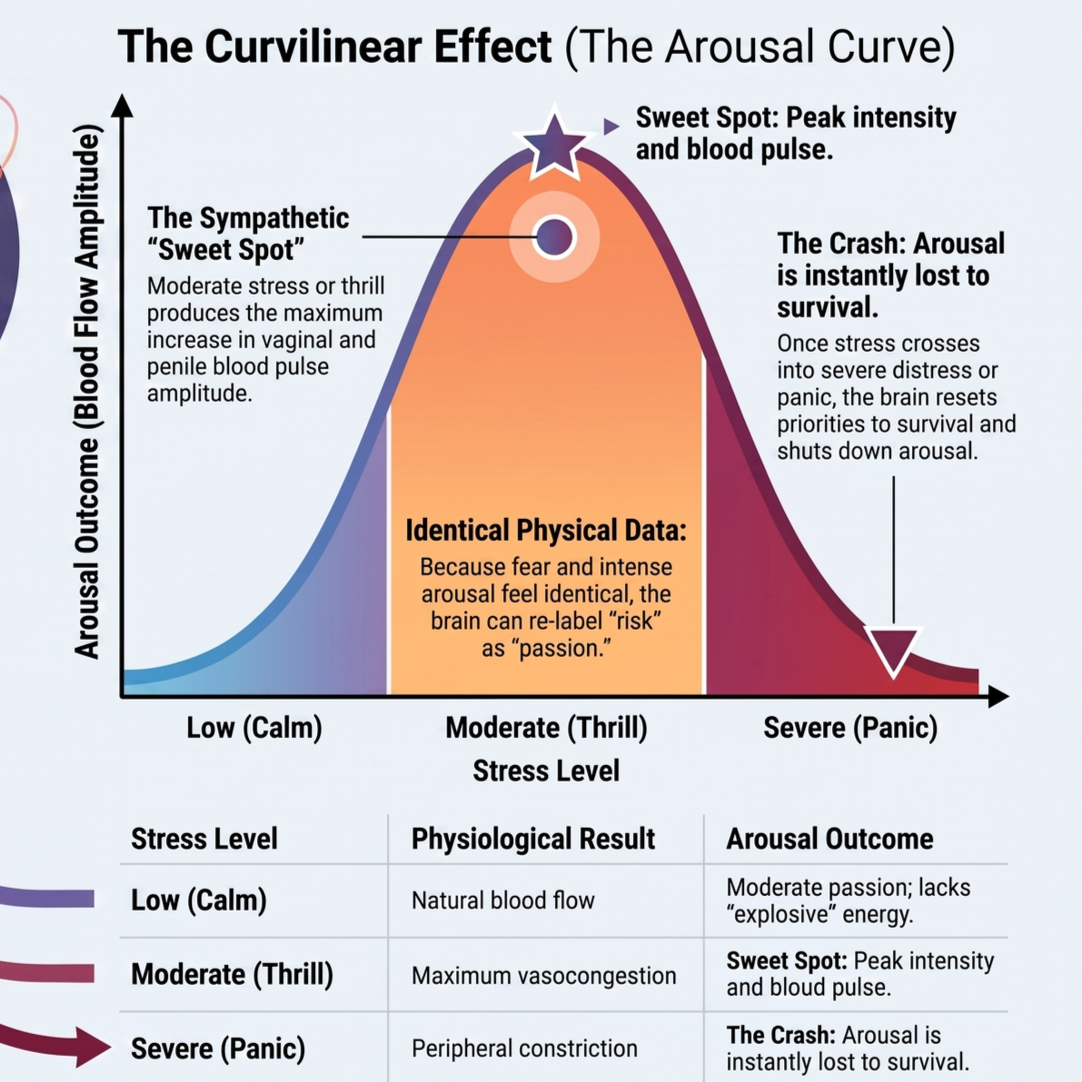
The intensity of anxiety and stress matter to sexual arousal
What is Arousal Nonconcordance?
Arousal nonconcordance is when there is a mismatch between mental and genital arousal.
Genital arousal can also occur as a localised physical reflex via the lower spinal cord. This localised reflex operates independently of the brain's emotional state or permission. What this means is that even if the brain is sending shut down signals, but there is genital stimulation, the genitals can still respond with arousal such as lubrication or an erection. The brain may be completely shut down on arousal, but the genitals are automatically responding to physical input. Examples of this include survivors of sexual assault who do not consent to sexual activity, experiencing genital responsiveness as a reflex to touch. The body’s response is not a reflection of consent and should never be taken as a sole signal of consent.
Furthermore, extreme anxiety can trigger genital responses even without physical touch. When the body is highly stressed, bursts of emotion produce massive, sudden surges of adrenaline which gets the blood pumping. The brain in a state of extreme anxiety simultaneously fires up the sympathetic nervous system in an electrical storm-like frenzy. The sheer magnitude of this electrical surge can overwhelm the brain’s inhibitory controls and have a spillover effect to the genitals.The sympathetic nerve fibers responsible for the 'fight or flight' response travel directly through the same pelvic nerve networks that control the genitals. Some sympathetic nervous system activation is needed for genital arousal to allow for blood flow, whereas heightened sympathetic activation (e.g. anxiety- fight or flight) constricts the genitals and draws blood away to prioritise survival. The sudden over-activation of the sympathetic nervous system can short-circuit this genital shutdown and accidentally cross-fire into the body's arousal pathways. This electrical misfire overrides the typical shut-down response and accidentally triggers the parasympathetic nerves to open the local blood vessels of the pelvis and genitals. At the same time, the massive surge in adrenaline is already pumping blood hard from the heart, forcing that blood directly into the newly opened vessels of the genitals.An example of this is the experience of an erection during an argument, or a veteran with PTSD experiencing spontaneous erections in moments of heightened stress. The erection is completely involuntary.
When anxiety, depression, or stress fuel sexual activity.
While these uncomfortable emotions typically act as a brake, some people find that when they feel these emotions they feel a desperate urge towards sex. In these instances, sex is no longer about desire, sex becomes a primary emotion regulation strategy. This occurs for approximately 10-20% of people where interest in sex feels like an urge when negative mood states are experienced. Rather than deactivating the sexual accelerator, in these individuals the sexual accelerator is activated during fight or flight to relieve the overwhelming emotional tension. The primary motivation is not pleasure but a desperation for relief.
Emotional sexualisation describes the funnelling of non-sexual emotions into a sexual impulse, in order to relieve it. The raw physiological tension is focused into an urgent craving for sexual activity to numb pain. This behaviour is then reinforced over and over again, due to the reward of orgasm and relief from pain, although short-term. The sexual relief temporarily switches off the distress, and this can turn into a compulsion over time. The brain has learnt to automatically command sex, whenever the individual feels overwhelmed.
How Sex Therapy Can Help
Sex therapy can help you better understand the unique relationship between anxiety and your experience of sexual arousal. Rather than assuming anxiety is simply something to eliminate, together we explore how your brain has learned to interpret different situations, what activates your sexual "accelerators" and "brakes", and how thoughts, emotions, beliefs, and past experiences influence your sexual response.
For some individuals, the work involves reducing performance anxiety, fear of pain, or catastrophic thinking that is suppressing arousal. For others, it is about understanding how stress, excitement, or risk have become intertwined with sexual arousal, and whether these patterns continue to serve them. We may also explore relationship dynamics, communication, emotional safety, and the broader context in which sexual intimacy occurs.
Sex therapy is not simply about improving sexual function. It is about understanding how your mind, body, and relationships work together to shape your unique experience of sexuality. As you gain a deeper understanding of these patterns, it becomes possible to cultivate contexts that support greater pleasure, intimacy, and sexual wellbeing.
I offer online sex therapy across Australia, supporting individuals and couples experiencing concerns related to anxiety, desire, arousal, intimacy, sexual functioning, and overall sexual wellbeing.
Written by Justine
References
Yehuda R, Lehrner A, Rosenbaum TY. PTSD and sexual dysfunction in men and women. J Sex Med. 2015;12(5):1107-1119.
Bancroft J. Sexual arousal and response — the psychosomatic circle. In: Human Sexuality and Its Problems. 3rd ed. Edinburgh: Churchill Livingstone Elsevier; 2009.
Lipshultz LI, Pastuszak AW, Goldstein AT, Giraldi A, Perelman MA, editors. Management of Sexual Dysfunction in Men and Women: An Interdisciplinary Approach. New York, NY: Springer; 2016.
IsHak WW, editor. The Textbook of Clinical Sexual Medicine. Cham, Switzerland: Springer International Publishing; 2017.
Rowland DL. Neurobiology of sexual response in men and women. CNS Spectr. 2006;11(8 Suppl 9):6-12.
