
What Is Sexual Pleasure and Why Does It Matter for Sexual Health?
Sexual pleasure is central to sexual wellbeing and sexual functioning. It is not an “extra” part of sexuality, but a core component of how individuals experience connection, satisfaction, and meaning in their sexual lives.
Sexual pleasure can be understood as both the physical and psychological enjoyment and satisfaction derived from solo or shared sexual activity. It can also be experienced through thoughts, imagination, and dreams, highlighting that sexuality is not just physical, but deeply connected to the mind.
Prefer to listen? This article is also available as an audio podcast.
Sexual pleasure is closely linked to both sexual function (how the body responds sexually) and sexual wellbeing (how we feel about our sexuality and ourselves).
To understand this more fully, it can be helpful to look at sexuality through a broader, more comprehensive lens.
What Are the Four Pillars of Sexuality?
A comprehensive approach to sexuality includes four interconnected pillars:
Sexual health
Sexual pleasure
Sexual wellbeing
Sexual justice
These pillars do not exist in isolation. They continuously influence one another and together shape a person’s overall experience of sexuality.
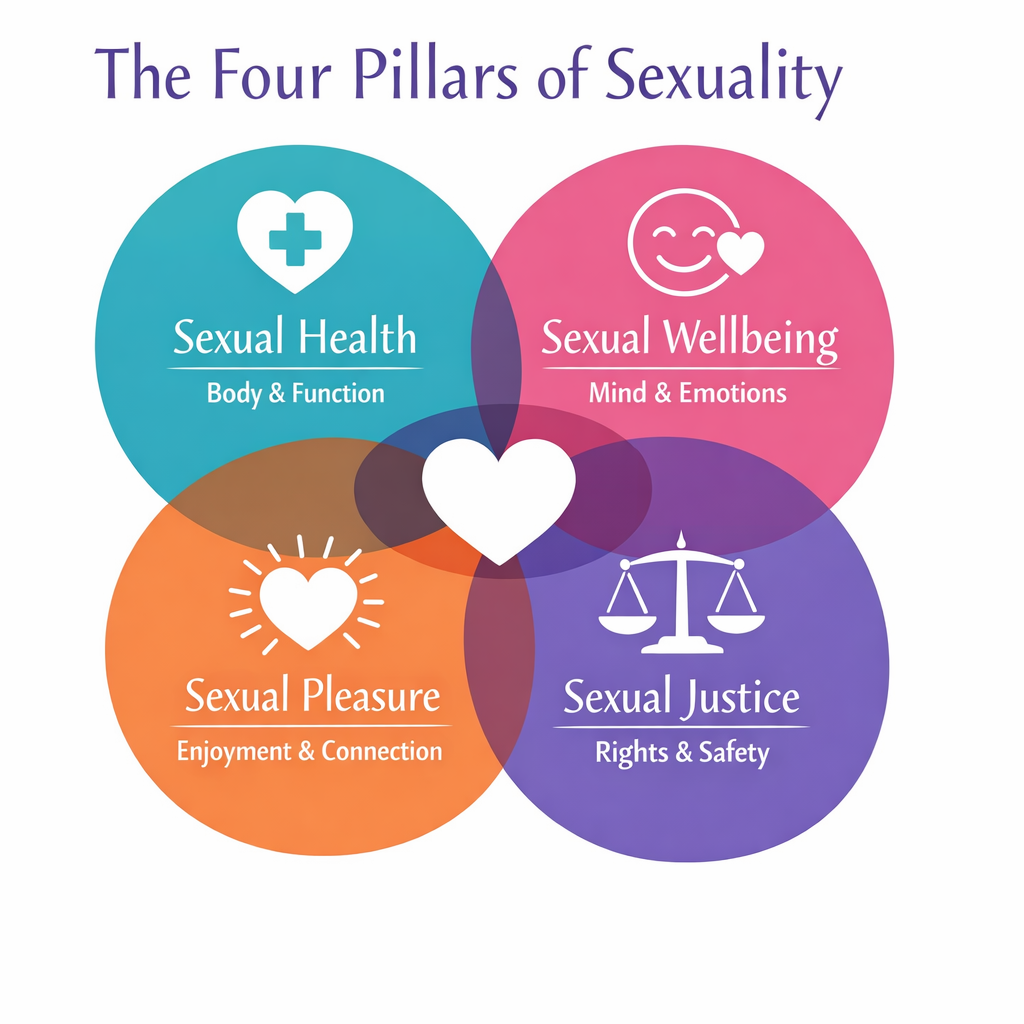
The Four Pillars of Sexuality
Sexual health
Sexual health includes the biological and medical foundations of sexuality: desire, arousal, and bodily function. It also includes reproductive health, STI prevention, and importantly, freedom from sexual violence.
Sexual wellbeing
Sexual wellbeing focuses on the psychological and emotional experience of sexuality. This includes self-esteem, comfort with one’s sexuality, resilience, and the ability to feel present and engaged in sexual experiences.
Sexual pleasure
Sexual pleasure is the lived, experiential aspect of sexuality: how satisfying, enjoyable, and meaningful sexual experiences feel. It is influenced by the body, the mind, relationships, and the broader environment.
Sexual justice
Sexual justice refers to the social and structural context of sexuality. This includes safety, autonomy, and freedom from discrimination or violence. Without this foundation, true sexual wellbeing is not possible.
Together, these pillars reflect the biopsychosocial nature of sexuality where biology, psychology, relationships, and social context all interact.
How Does Sexual Pleasure Influence Sexual Function?
Desire, Arousal, and Orgasm
Sexual pleasure is a key mechanism underlying desire, arousal, and orgasm.
Desire is often driven by the anticipation of pleasure. If sexual experiences are pleasurable, desire is more likely to emerge. When pleasure is absent, desire often decreases.
Similarly, arousal supports pleasure. If arousal is inhibited; whether biologically or psychologically, pleasure is reduced, which can then impact desire and orgasm.
How Does Pleasure Support the Body?
Sexual pleasure also plays a role in maintaining physical sexual function.
Experiencing pleasure requires a level of connection with one’s body. When individuals feel disconnected due to shame, fear, or negative messaging, this can interfere with arousal and bodily responses.
Conversely, pleasure-driven sexual activity can:
support blood flow and tissue health
maintain erectile and vaginal function
improve sleep, relaxation, and pain management
support overall physical wellbeing
Regular engagement with pleasurable sexual experiences can help preserve sexual function over time.
Does Sexual Pleasure Influence Safer Sex?
Sexual pleasure is one of the strongest motivators for sexual behaviour. When sexual health is approached purely from a risk or disease-prevention perspective, it can disconnect from how people actually engage in sex. People are often motivated by connection, closeness, and pleasure, not just health outcomes.
When pleasure is included in conversations about safe sex:
condom use increases
individuals are more likely to engage in protective behaviours
sexual experiences feel more satisfying and sustainable
At the same time, pleasure is complex. It does not always equate to safety or wellbeing.
Are There Complexities with Sexual Pleasure?
Yes—sexual pleasure is not always a straightforward indicator of a healthy experience.
Pleasure can sometimes occur in contexts that are not safe, consensual, or aligned with a person’s values. This highlights that pleasure alone is not enough and must be considered alongside consent, safety, and wellbeing.
Approaching sexuality through fear or shame is not effective. Instead, understanding the role of pleasure allows for more meaningful, realistic, and supportive conversations about sexual health.
How Does Sexual Pleasure Influence Sexual Wellbeing?
Sexual pleasure is foundational to sexual wellbeing.
It supports:
self-esteem and body confidence
emotional connection and relationship satisfaction
communication about needs, boundaries, and preferences
autonomy and self-determination
When pleasure is prioritised, individuals are more likely to:
understand their own needs and desires
communicate openly with partners
experience sex as something mutual and meaningful
Sexual pleasure also broadens the definition of sexuality beyond intercourse, allowing for more flexible, diverse, and satisfying experiences.
Importantly, sexual pleasure is closely linked to autonomy and consent. Pleasure is most meaningful when it is freely chosen, safe, and aligned with personal values.
How Sex Therapy Can Help
Sex therapy provides a space to explore how sexual pleasure, function, and wellbeing are connected in your own experience.
Rather than focusing only on the physical aspects of sex, sex therapy supports you to:
understand what supports or inhibits pleasure
reduce shame, pressure, and performance anxiety
reconnect with your body and sensations
improve communication and intimacy in relationships
explore sexuality in a way that aligns with your values
Sex therapy recognises that sexual difficulties are rarely just “biological problems,” but are shaped by the interaction between body, mind, and relationship.
I offer online sex therapy across Australia, providing a confidential and supportive space to explore your sexual wellbeing, deepen your understanding of your sexuality, and move toward more connected and satisfying experiences.
Written by Justine
References
1. Laan ET, Klein V, Werner MA, Van Lunsen RH, Janssen E. In pursuit of pleasure: A biopsychosocial perspective on sexual pleasure and gender. International Journal of Sexual Health. 2021;33(4):516-36.
2. Ford JV, Corona Vargas E, Finotelli Jr I, Fortenberry JD, Kismödi E, Philpott A, et al. Why pleasure matters: Its global relevance for sexual health, sexual rights and wellbeing. International Journal of Sexual Health. 2019;31(3):217-30.
3. Gianotten WL, Alley JC, Diamond LM. The health benefits of sexual expression. International Journal of Sexual Health. 2021;33(4):478-93.
4. Kantor LM, Lindberg L. Pleasure and sex education: the need for broadening both content and measurement. American Journal of Public Health. 2020;110(2):145-8.
5. Gruskin S, Yadav V, Castellanos-Usigli A, Khizanishvili G, Kismödi E. Sexual health, sexual rights and sexual pleasure: meaningfully engaging the perfect triangle. Sexual and Reproductive Health Matters. 2019;27(1):29-40.
6. Mitchell KR, Lewis R, O'Sullivan LF, Fortenberry JD. What is sexual wellbeing and why does it matter for public health? The Lancet Public Health. 2021;6(8):e608-e13.
7. Ford JV, Corona-Vargas E, Cruz M, Fortenberry JD, Kismodi E, Philpott A, et al. The World Association for Sexual Health’s declaration on sexual pleasure: a technical guide. International Journal of Sexual Health. 2021;33(4):612-42.
8. Mark K, Corona-Vargas E, Cruz M. Integrating sexual pleasure for quality and inclusive comprehensive sexuality education. International Journal of Sexual Health. 2021;33(4):555-64.
9. Zaneva M, Philpott A, Singh A, Larsson G, Gonsalves L. What is the added value of incorporating pleasure in sexual health interventions? A systematic review and meta-analysis. PLoS One. 2022;17(2):e0261034.
10. Jones A. Sex is not a problem: the erasure of pleasure in sexual science research. Sexualities. 2019;22(4):643-68.
11. Wood R, Hirst J, Wilson L, Burns-O'Connell G. The pleasure imperative? Reflecting on sexual pleasure’s inclusion in sex education and sexual health. Sex Education. 2019;19(1):1-14.
12. Coleman E, Corona-Vargas E, Ford JV. Advancing sexual pleasure as a fundamental human right and essential for sexual health, overall health and well-being: An introduction to the special issue on sexual pleasure. International Journal of Sexual Health. 2021;33(4):473-7.
