
How Do Erections Work? An Analogy to Understand Erections
An erection is like filling up a balloon attached to a tap. When this process runs smoothly, an erection happens! When this process comes into any challenges this is where there may be moments of erectile difficulty, or if the challenges are sustained, erectile dysfunction. Medication such as PDE5 inhibitors (viagra, cialis) target the process to ensure the smooth running of the balloon being filled at the tap.
If you prefer to listen rather than read, here is my podcast explaining how erections work.
How does an erection happen?
Imagine a tap with a balloon (corpora cavernosa- the internal chambers of the penis) attached to it. At first this may sound simple, but read on and you will realise, it is not so simple!
First, the tap itself needs to be turned on to get water (blood) flowing. This is the process of sexual arousal. Through mental and physical stimulation, the brain and nervous system send signals to get the blood flowing in the first place.
Here, two chemical messengers work as a team. A chemical called Vasoactive Intestinal Peptide(VIP) acts on the tap itself, widening the supply pipes so water (blood) can rush in at high pressure. At the exact same time, the nerves release Nitric oxide (NO), which stimulates the production of cGMP to prepare the balloon to be filled.
In its resting state, the rubber of the balloon (the smooth muscle of the corpora cavernosa) is inflexible and rigid, only allowing trickles of water in. In an erection, the water rushes in at high pressure. For this to work, the rubber (muscle) of the balloon needs to be stretchy and relaxed to accommodate the rush. If the rubber remains inflexible and rigid, it cannot expand. cGMP causes the rubber in the balloon to relax, allowing the rushing water to successfully fill the balloon and expand it
Here’s where it gets a bit tricky. Now imagine the balloon also has little holes that drain the water out (drainage veins). So water is filling the balloon, but also leaking out (venous leak). There needs to be a mechanism to plug these drain holes to keep water in the balloon, and to create the firm pressure needed for an erection. The solution to this is the balloon is encased in a firm leather sheath (fibrous membrane called the tunica albuginea that surrounds the corpora cavernosa). When arousal is high and the water from the tap rushes into the balloon, the balloon expands quickly and in doing so pushes against the sheath, plugging its own escape valves closed. This keeps the pressure in the balloon and creates firmness.
The balloon also needs to be tightly fitted to the tap. If it is not tightly fitted, water will leak back out, and the balloon will not properly fill. The ballon needs a tight seal at the tap to keep water trapped under high pressure. The pelvic floor muscles at the base of the penis (specifically the ischiocavernosus) contract to compress the base of the penis, which maximizes hardness and creates extra pressure.
In everyday functioning (not sexual activity) the tap is on a constant trickle and the drains allow the water to trickle back out (blood circulation which contributes to penile health).
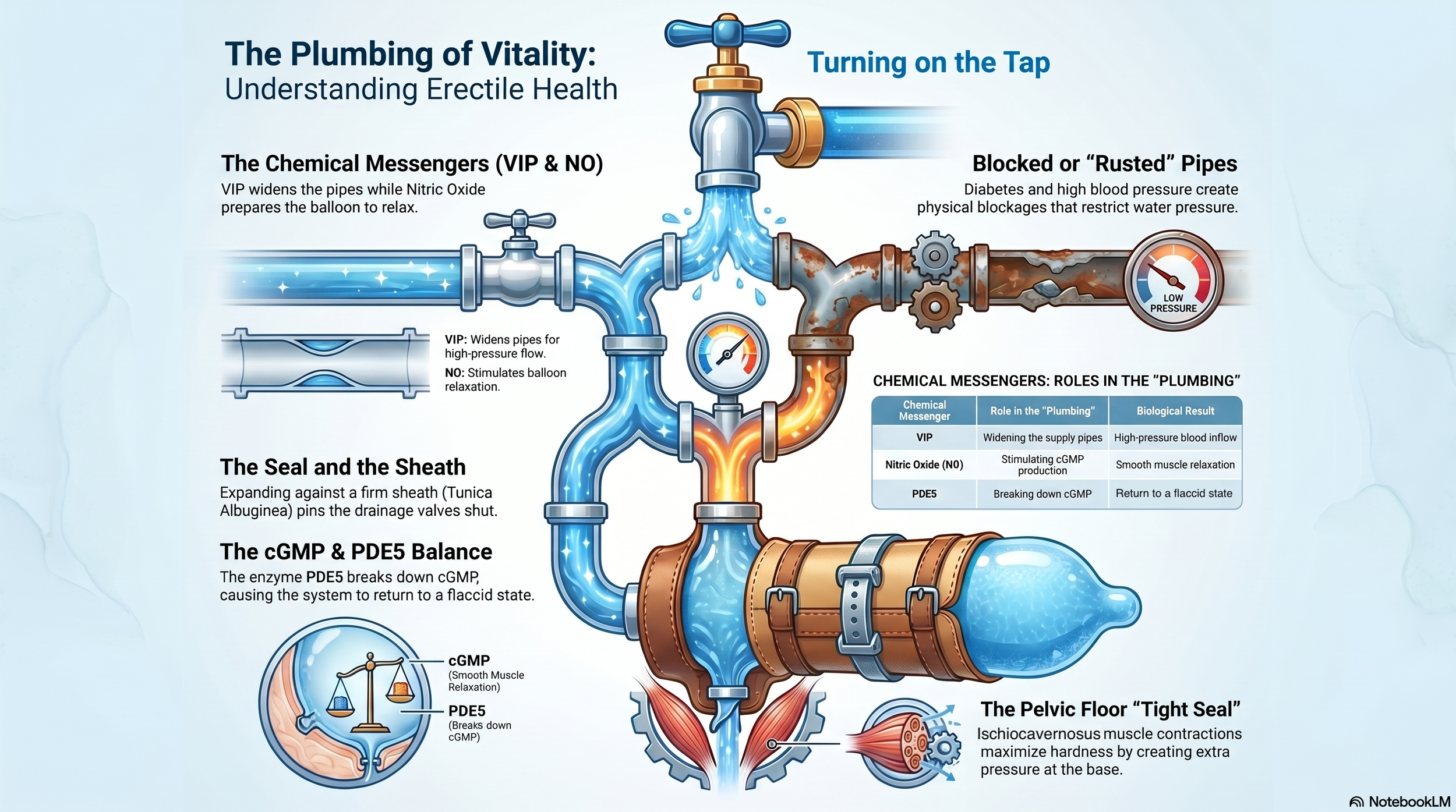
Visualising the tap and balloon analogy for erections
Why do problems with erections occur?
Without turning on the tap of arousal at high pressure, the rest of the plumbing cannot activate fully, and the balloon cannot be filled with rushing water. If arousal is not present both mentally and physically, the balloon will not fill, an erection will not occur. This is because when there is no arousal, VIP that widens the arteries for high blood flow, and NO that is involved in relaxing the smooth muscle will not be released. To understand the process of arousal and why this is an essential component of sexual function, read my blog here.
Other times the tap may be on but there are blockages or rusting at the tap and piping due to diabetes, high blood pressure, or other chronic cardiovascular health conditions. This will affect the amount of water that is able to be released into the balloon, even when mental arousal is high.
cGMP relaxes the balloon to allow for water to fill in, but there is less water and so the balloon is filling up much more slowly, which means that water is also draining out (the drains are not being plugged by the ballon’s pressure against the sleeve). At the same time, PDE5 is at work. PDE5 is an enzyme that naturally breaks down this cGMP. If the water is slow, and cGMP is being broken down, eventually the balloon will return to an inflexible, more rigid state.
Given that difficulties with erection are often a symptom of an underlying biological issue, it is essential to speak with a doctor about any concerns you have with your erections. In the case of underlying health issues, prescribed medications for these health issues may then have a positive effect of restoring erectile function.
Read more:
How do PDE5 inhibitors work?
PDE5 inhibitors temporarily paralyse the PDE5 enzyme which breaks down cGMP.
That is why PDE5 inhibitors can help in these cases: because the water is not filling up the balloon fast enough due to the damaged pipes, blocking the PDE5 enzyme preserves whatever cGMP is naturally made. cGMP is then able to sustain and increase the flexibility of the balloon, allowing water to more easily fill the balloon, and giving the tap more time to successfully fill it.
It is important to note that PDE5 inhibitors do not create arousal. They do not turn on the tap! They only work when there is arousal present and the tap is releasing water and NO which in turn creates cGMP. It is a misconception that PDE5 creates spontaneous erections. For an erection to occur, arousal must be activated through both mental and physical stimulation. Again, this is where it is important to understand arousal, read my blog here.
Important note: only take PDE5 that has been prescribed by a doctor
How Sex Therapy Can Help
While medications like PDE5 inhibitors can support the biological side of erections, they do not address the psychological and relational factors that are often at play that impact arousal.
Sex therapy supports individuals and couples to understand how arousal, anxiety, pressure, and relationship dynamics influence erectile function. Even when there is a clear biological component, the experience of erectile difficulty can quickly become linked with performance anxiety, frustration, or avoidance, which further disrupts the “tap and balloon” process.
Sex therapy focuses on:
• reducing performance pressure and anxiety
• rebuilding confidence in the body’s natural responses
• shifting away from goal-oriented sex toward pleasure-focused intimacy
• improving communication and understanding within the relationship
• supporting couples to become a sexual team rather than experiencing the issue in isolation
When biological, psychological, and relational factors are addressed together, erectile function is more likely to improve in a sustainable and meaningful way.
I offer online sex therapy across Australia, providing a confidential and supportive space to explore erectile concerns, understand what is happening in your body, and work toward more relaxed, connected, and satisfying sexual experiences.
Written by Justine
