
Treatment Options for Erectile Dysfunction
Before you read this blog on the treatment options for Erectile Disorder (ED), it is a good idea to have a basic understanding of how ED is defined, and possible factors that contribute to ED (read my blog on this here).
If you think you are struggling with ED, or simply concerned about penis function, it is important as a first step to consult with your doctor/GP. To put it simply, erections require functioning blood flow, and difficulties in erections can point to health issues impacting blood flow such as diabetes, high cholesterol, blood pressure issues, and heart disease.
ED is not always biological; there are times where ED is primarily psychological. Even so, it is still important to see a GP to rule out any possible underlying biological causes. Even when ED is primarily biological, this can have a significant impact on psychological health, which then perpetuates erectile difficulties.
A helpful metaphor to think about erections is a tap and plumbing.
In this metaphor, the plumbing represents the biological systems: the blood vessels, nerves, hormones, and the penis itself. When the plumbing is functioning well, the pipes are clear, clean, and free from blockages. Blood can flow smoothly, allowing an erection to occur.
The tap represents the brain. The tap needs to be turned on for the water to flow through the pipes. It does not matter how well-functioning the plumbing is if the tap is not activated. Psychological factors such as stress, anxiety, performance pressure, relationship conflict, or low mood can prevent the tap from turning on fully.
At other times, the tap may be turned on: desire is present, sufficient stimulation is occurring but there may be an issue within the plumbing itself. A blockage, narrowing, or reduced blood flow can interfere with the process. Rust in the pipes.
Erectile functioning depends on both systems working together. Understanding this interplay helps guide appropriate treatment options, which we will explore below.
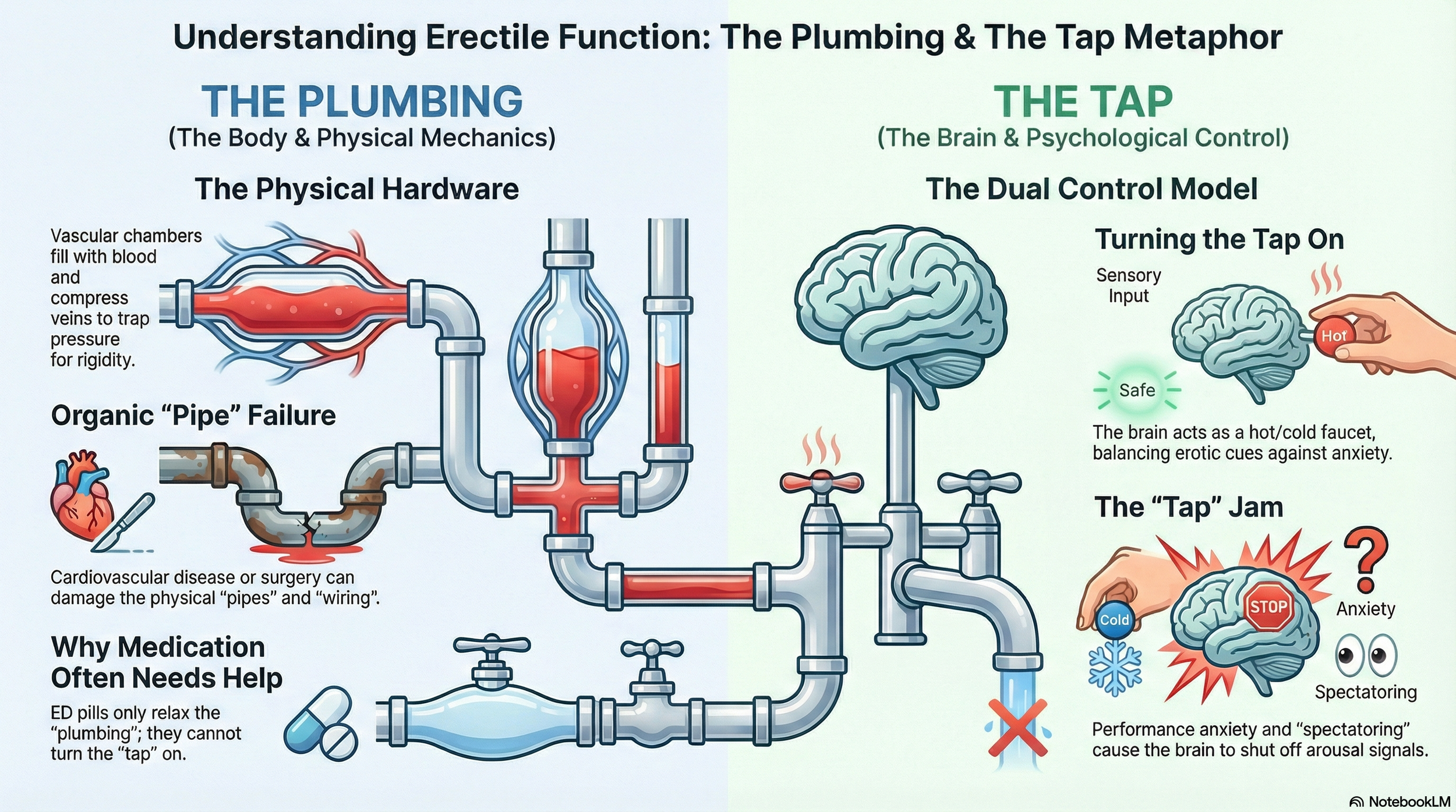
Interplay betwen the tap and the plumbing. Both the tap and the plumbing work together for overall erection health.
Lifestyle Changes That Improve Erectile Function
Improving your overall health and wellbeing, and managing any underlying medical conditions is the safest and most beneficial long-term treatment. It is a crucial first step in ED. This includes exercise (particularly focusing on cardiovascular health- again, blood flow!), eating nutritious foods, quitting smoking, and reducing alcohol intake.
Pros: This approach is safe, and the benefits of this are far-reaching: overall health, including mental and emotional wellbeing. This can prevent ED progression, improve early signs of ED, and in some cases reverse ED completely!
Cons: This approach requires your motivation and consistency. This does not address the psychological impacts of ED which may inadvertently perpetuate ED. It also does not address ED that is psychologically induced.
Sex Therapy for Erectile Dysfunction
Psychological factors of ED include performance anxiety, monitoring performance, relationship distress, and loss of sexual confidence. These psychological factors can impact on arousal and desire for sex. Sex Therapy specifically explores the psychological and relational factors underlying or resulting from ED.
If partnered, couples sex therapy is recommended over individual sex therapy. This is because the couple as a sexual team is absolutely essential in supporting and implementing long-lasting improvements in both sexual and relationship satisfaction. Sexual dysfunction also impacts both partners, and often a partner experiences their own sexual problems in response to ED. Couples can often get trapped together in a cycle of anxiety which may eventually lead to sexual avoidance. Treating the couple addresses this cycle, supporting confidence and enjoyment for both partners, which then enhances the overall sexual relationship.
Pros: Therapy and medication yields better outcomes than medication alone. Therapy supports rebuilding sexual health, confidence, and pleasure.
Cons: Time and commitment is required to see results. It can be feel very vulnerable to speak about sexual topics with a professional.
Oral Medications for Erectile Dysfunction
Any medication should be prescribed by a doctor. A doctor will understand your overall medical history including conditions or medications to take into account.
Non-prescribed medication carries huge risks, including interactions with other substances or medications that carry the risk of sudden death, and non-prescribed medication such as “Viagra” have been found to include other toxic chemicals or illicit substances.
Overall, oral medications work by keeping the blood vessels in the penis relaxed to promote blood flow into the penis during sexual arousal and manual stimulation.
Sildenafil (Commonly known as Viagra): The blue pill!
Pros: highly effective, well researched since 1998. Up to 75% of users can engage in sexual intercourse. It tends to be more cost-effective than other options due to generic, off-brand, options.
Cons: It can take 30-60 minutes for effect, requiring planning. Generally its ability to act is within a 4-5 hour window. Its absorption is impacted by heavy or fatty meals. Side effects can include headaches, flushing, and visual abnormalities.
Tadalafil (Cialis)
Pros: Its efficacy can last up to 36 hours. It is not affected by food intake. It is approved for once-daily dosing, eliminating the need to time dosing with intercourse. It is associated with improved psychological outcomes for treatment satisfaction.
Cons: Peak efficacy is approximately 2 hours after administration. Side effects may include back pain, and muscle pain.
Avanafil (Stendra)
Pros: This is the most rapid onset medication, working in 15-30 minutes. Food does not impact its absorption. Its window of efficacy is up to 6 hours.
Cons: It is a more recently approved medication, and there is a smaller body of research and evidence. Side effects include headaches, flushing, and nasal congestion.
Oral medication other thoughts:
Many men incorrectly assume that this medication will result in spontaneous erections, or an increase in libido. In fact, these medications require arousal and manual stimulation to take effect. If a person has consumed this medication but is not “aroused”, an erection will not occur.
Vacuum Erection Devices (VEDs) for Erectile Dysfunction
A VED is a plastic cylinder with a constriction ring placed over the penis. Negative pressure is created to draw blood into the penis, while the constriction ring traps the blood and maintains the erection.
Pros: These are highly effective 90% of the time, regardless of the cause of ED. They are a one-time purchase.
Cons: Although these are highly effective, they can feel too “medical”, cumbersome to use, and interrupt erotic flow. This leads to a high discontinuation rate. Side effects may include penile pain, bruising, numbness, and delayed ejaculation.
Intracavernosal Injections (ICI) for Erectile Dysfunction
A prescribed medication (e.g. alprostadil) is directly injected with a fine needle into the side of the penis. This is a second-line treatment, after first-line treatments do not work or are unsuitable.
Pros: An erection is produced in 5-15 minutes for approx. 70-94% of users. Given that it works directly on penile tissue, this is a preferred treatment for men with nerve damage who do not respond to oral pills.
Cons: Injections may be temporarily painful which is an issue for those with needle anxiety or fear of pain. If used incorrectly there can be scarring. There is a risk of a painful prolonged erection that can last more than 4 hours.
Intraurethral Suppositories (MUSE) for Erectile Dysfunction
This is a medicated pellet of alprostadil which is pushed into the opening of the urethra with a small plastic applicator. Application is advised to occur after first urinating to assist with dissolving and absorption.
Pros: It is an alternative to an injection.
Cons: It is significantly less effective than injections and can cause aching or burning in the penis, dizziness, and even bleeding.
Surgical Penile Prosthesis (Implants) for Erectile Dysfunction
This is a last resort treatment, when all above treatments are not effective or tolerated. This involves bendable rods or inflatable cylinders surgically implanted inside the penis.
Pros: It is permanent and highly reliable. The erection feels natural and there is high patient and partner satisfaction.
Cons: It is expensive and invasive. It is completely irreversible. There are risks which include surgical complications, infection, and device failure over time. Modern implants have successfully reduced risk of severe infection to 1-3%.
Online Therapy for Erectile Dysfunction in Australia
While medical treatments can support the biological “plumbing,” therapy addresses the “tap”: the psychological and relational factors that so often sustain erectile difficulties.
Sex therapy provides a structured, safe space to explore:
Performance anxiety and fear of failure
Monitoring and spectatoring during sex
Loss of sexual confidence
Shame or embarrassment
Avoidance patterns
The impact of pornography use (if relevant)
Relationship tension that may be interfering with arousal
If you are partnered, couples sex therapy is strongly recommended. Erectile dysfunction rarely affects only one person. Over time, partners may develop their own anxiety, self-doubt, or sexual withdrawal in response. Couples can become trapped in a cycle of tension, pressure, and avoidance, which further reinforces ED.
Working as a sexual team reduces blame and shifts the focus from “fixing the penis” to strengthening the sexual relationship as a whole. Together, couples can rebuild:
Emotional safety
Erotic confidence
Pleasure-focused intimacy
Communication around desire and expectations
When the tap and the plumbing are both supported, outcomes are significantly improved.
I offer online sex therapy for couples and individuals across Australia, supporting individuals and partners navigating erectile difficulties in a confidential and structured way.
A Final Reflection: ED Is Treatable
Erectile dysfunction can feel deeply personal. It can impact confidence, identity, and relationship dynamics. Many men experience shame and silence around ED, which often makes the problem feel bigger and more isolating than it needs to be.
The good news is that ED is highly treatable.
Sometimes treatment begins with lifestyle changes. Sometimes it involves medication. Sometimes it requires addressing anxiety, trauma, or relational patterns. Most often, it is a combination.
The most important step is not guessing or self-blaming, but seeking appropriate medical and psychological support.
An erection is not simply a measure of masculinity or worth. It is a complex interaction between biology, psychology, and relationship dynamics.
With the right support, both the tap and the plumbing can be addressed: and a satisfying, confident sexual relationship can be rebuilt.
Justine
References:
Burnett AL, Nehra A, Breau RH, Culkin DJ, Faraday MM, Hakim LS, et al. Erectile Dysfunction: AUA Guideline. J Urol. 2018;200(3):633-641.
Krzastek SC, Bopp J, Smith RP, Kovac JR. Recent advances in the understanding and management of erectile dysfunction. F1000Research. 2019;8(F1000 Faculty Rev):102.
Wessells H. Management of erectile dysfunction. In: Dahm P, Dmochowski RR, editors. Evidence-Based Urology. 2nd ed. John Wiley & Sons Ltd; 2018. p. 545.
Hatzimouratidis K, Amar E, Eardley I, Giuliano F, Hatzichristou D, Montorsi F, et al. Guidelines on Male Sexual Dysfunction: Erectile Dysfunction and Premature Ejaculation. Eur Urol. 2010.
Hackett G. Erectile Dysfunction. In: Wylie K, editor. ABC of Sexual Health. 3rd ed. Chichester, UK; Hoboken, NJ: John Wiley & Sons Ltd; 2015. p. 68.
