
Premature Ejaculation: Causes, Myths, and How Sex Therapy Can Help
What is Premature Ejaculation?
Premature Ejaculation (PE) is ejaculation that consistently occurs prior to penetration, or within approximately one minute of penetration.
Defining features include:
- Lack of control: the sense that there is the inability to delay or control ejaculation.
- Distress: there is significant personal consequence such as frustration or sexual avoidance
PE is generally divided into two main categories:
- Lifelong PE: present at the very first sexual experience as well as throughout subsequent sexual experiences
- Acquired PE: PE develops later, after a period of relatively normal ejaculatory function
For a formal diagnosis according to the DSM-5, PE symptoms must have been present for a minimum of 6 months, and occurring approx. 75-100% of sexual occasions. For PE to be diagnosed, it cannot be better explained by another cause such as a mental disorder, medical conditions, or significant life stressors.
PE may also be generalised to all situations and partners, or it may be situational and limited to specific partners or circumstances.
How Common is Premature Ejaculation?
PE is the most common male sexual disorder overall, affecting both young and older men. This often surprises people, as Erectile Dysfunction, is most often thought to be the most common (it is most common in terms of older men).
Estimates suggest that up to 40% of all men experience PE, although it is likely to be closer to 20-30% in the general male population. Prevalence varies due to how PE is defined. When strict clinical criteria is applied, prevalence significantly drops to 1-5% of men. However, this indicates that while many men do not fit the criteria for PE clinically, many men are dissatisfied with their experience of ejaculation.
What Causes Premature Ejaculation?
There is a complex interplay between biology, psychology, and relationship factors when it comes to the causes of PE.
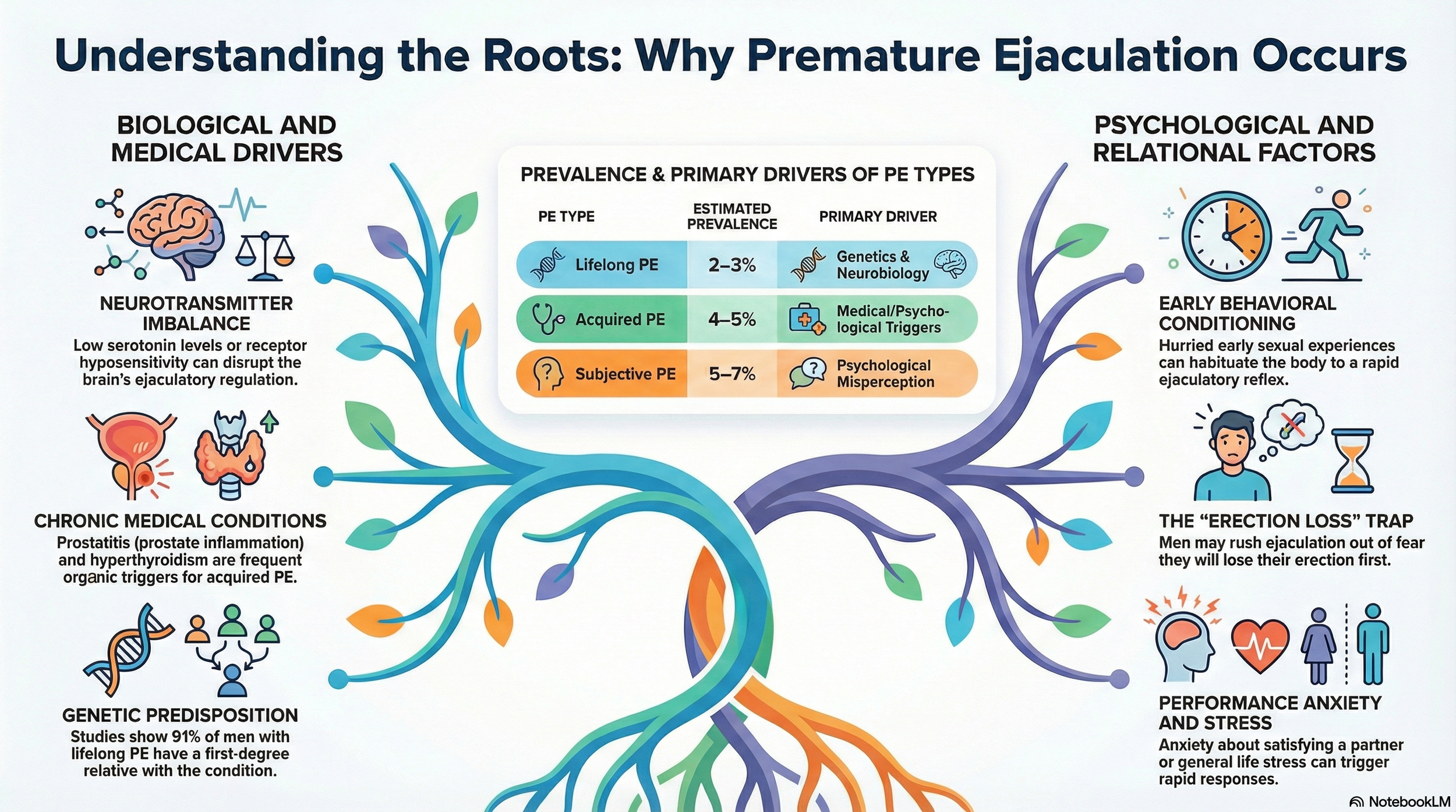
The interplay between biology, psychology, and relationships.
Biological: Serotonin regulates ejaculation. Therefore, genetic predispositions that impact how the brain processes serotonin can impact ejaculation. Genetic predispositions tend to be the case in lifelong PE. In acquired PE physical issues such as the inflammation or infection of the prostate, hyperthyroidism, or substance use or substance withdrawal can be a factor in PE.
Psychological: Anxiety around performance, low confidence, stress, and depression can contribute to PE. Anxiety can activate the body’s fight or flight response which prematurely primes an ejaculatory response. Anxiety can also lead to both consciously or unconsciously rushing to ejaculate, especially if there are concerns about erection. Given this link with erection concerns, it is unsurprising that approximately 30% of men with PE also struggle with ED. A lack of sexual self-confidence can interfere with understanding of the body’s cues, resulting in the loss of ejaculatory control.
PE can also be a conditioned reflex. This can happen if a man’s early sexual experiences were hurried due to anxiety, guilt, fear, or pressure. The body associates sexual arousal with rapid climax.
Relational: If there is pressure to perform, unrealistic expectations about sex, negative partner responses, control struggles, fear of intimacy and commitment, poor couple communication, the other partner’s sexual dysfunction- all of these can contribute to or maintain PE.
Societal and Cultural factors: Rigid values and strict moral codes regarding sexuality can evoke anxiety, guilt, and shame. Skills deficits due to a lack of knowledge can amplify the inability to control the ejaculatory reflex. Cultural expectations can also shape whether a man is concerned that they experience PE or not.
Myths About Premature Ejaculation
PE is purely psychological: PE, especially lifelong PE is rooted in neurobiology and genetics. Mental states especially anxiety can play a significant role in PE, but not all the time.
PE is mainly a young person’s issue and goes away with age: the prevalence of PE remains relatively consistent across all age groups, whereas ED tends to increase heavily with age.
A person with PE is selfish: many individuals with PE are not only concerned with their own pleasure, rather they experience severe performance anxiety and may in fact be over eager to please their partners.
How Premature Ejaculation Affects Individuals and Relationships
The following are possible impacts on individuals on relationships experiencing PE.
Individuals:
- Loss of self-esteem and confidence
- Lack of control and performance anxiety
- Emotional distress and avoidance
- Can act as a barrier to dating
Relationships:
- Decreased sexual satisfaction due to an abrupt ending (not necessarily PE itself- but the ending of intimacy due to shame and anxiety)
- Feelings of rejection and anger when misunderstood and taken personally
- Shared sexual avoidance
- Fertility concerns
When to Seek Support
Persistent distress for you or your partner
If your mental health is taking a hit
If there is significant relationship strain
If PE is a sudden or new problem
You experience anxiety spirals
Many people delay treatment out of shame and embarrassment, and the hope that PE will resolve on its own. However, PE is unlikely to change by itself, and delaying support can often worsen the issue due to psychological and relational impacts.
To understand your treatment options, read my blog on how PE is treated and managed here.
Can Sex Therapy Help Premature Ejaculation?
Sex therapy supports individuals to build sexual sensory awareness. This allows individuals to understand their physical signs of the “point of ejaculatory inevitability”: to slow down or pause before this point of “no return” is crossed. In sex therapy you will be provided with physical control techniques to build mastery over the ejaculatory reflex.
Overall, you will gain greater insight into your body, signs of arousal, physical tension, and the build-up of excitement that can lead to faster climax.
When sex feels pressured or anxiety-driven, this can be a significant distraction and contribute to PE. Sex therapy explores how to gently break this cycle, creating space to be present in sexual intimacy. Presence allows for pleasure rather than pressure.
Sex therapy also supports the couple in strengthening their relationship, improving communication, and working together as a sexual team. This is a collaborative approach to PE, rather than seeing one individual as “the problem.” The couple is empowered to navigate this together, enhancing their overall sexual satisfaction and wellbeing.
Taking the First Step
It is always advisable to speak to a GP first to explore possible biological contributors and to seek medical treatment where relevant.
Taking the first step requires courage. It is normal to feel nervous or embarrassed. However, PE is both common and treatable. Delaying support often allows anxiety and avoidance to become more entrenched.
Support is available:
I offer online sex therapy across Australia, supporting individuals and couples navigating premature ejaculation with compassion, structure, and evidence-based strategies. Together, we can reduce performance pressure, rebuild confidence, and create a more relaxed and satisfying sexual experience.
Written by Justine
References:
Waldinger MD. Problems of Ejaculation and Orgasm in the Male. In: Wylie K, editor. ABC of Sexual Health. 3rd ed. Chichester, UK: John Wiley & Sons Ltd; 2015. p. 73.
Hatzimouratidis K, Amar E, Eardley I, Giuliano F, Hatzichristou D, Montorsi F, et al. Guidelines on male sexual dysfunction: erectile dysfunction and premature ejaculation. Eur Urol. 2010;57(5):804-14.
Vukina J, McBride JA, Carson CC, Coward RM. Premature ejaculation. In: Dahm P, Dmochowski RR, editors. Evidence-Based Urology. 2nd ed. John Wiley & Sons Ltd; 2018. p. 569-77.
Betchen SJ. Premature Ejaculation: An Integrative, Intersystems Approach for Couples. J Fam Psychother. 2009;20(2-3):241-60.
Melnik T, Glina S, Rodrigues OM Jr. Psychological intervention for premature ejaculation. Nat Rev Urol. 2009;6(9):501-8.
Rowland DL, Rose P. Understanding & Treating Premature Ejaculation. Nurse Pract. 2008;33(10):21-7.
Renshaw DC. Premature Ejaculation Revisited—2005. Fam J. 2005;13(2):150-2.
