Consent and Sexual Health: Understanding the Spectrum
Sexual health can be thought of not only as the physical health component of sexuality, but it also includes the emotional, psychological, and relational components of wellbeing.
A key foundation to sexual health is consent. Without consent, there cannot be the experience of sexual health.
When it comes to consent, this is the optimal. This is the expectation that we need to be fostering and aiming for. Anything below consent is suboptimal.
The Spectrum of Permission
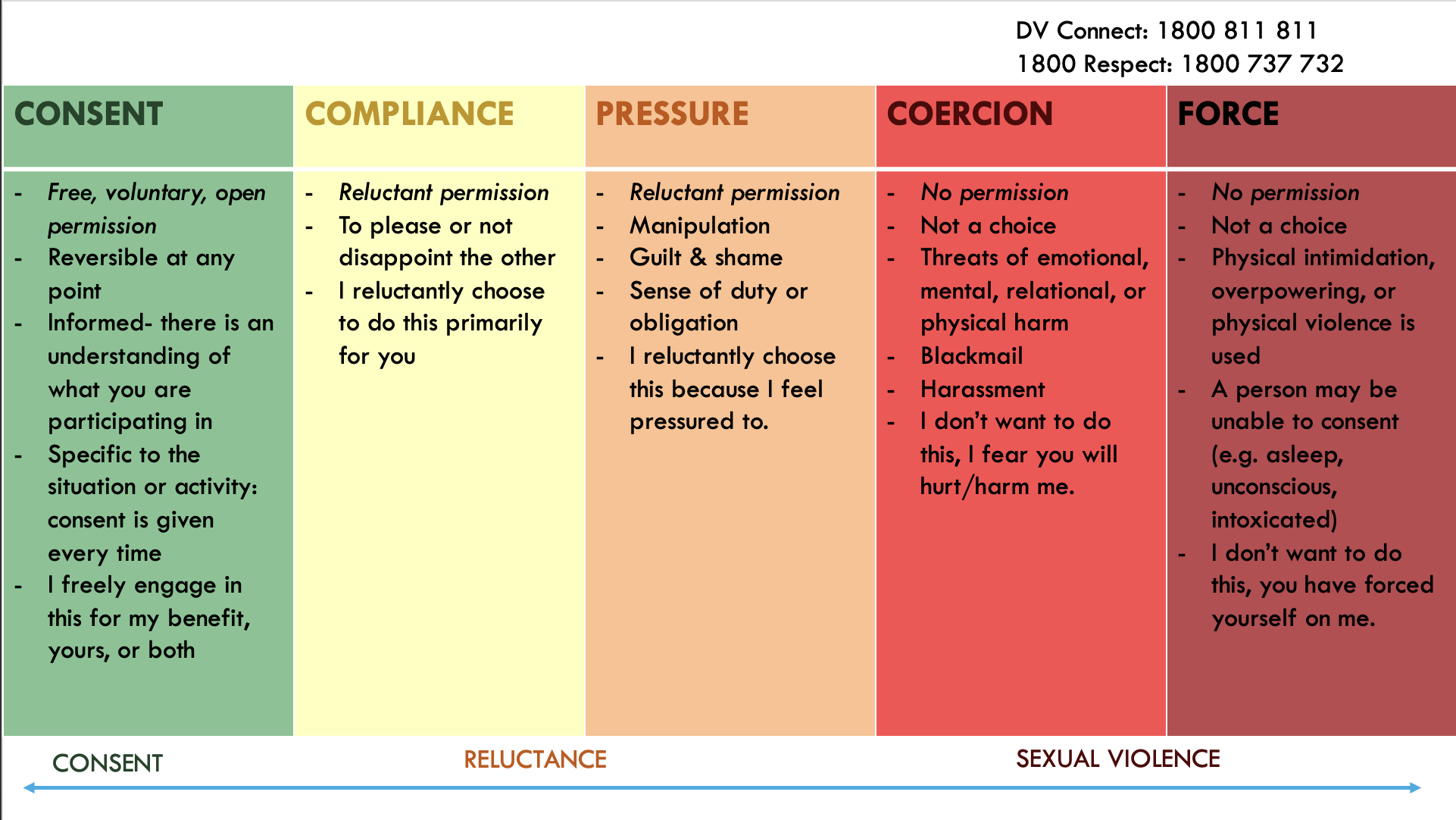
Consent is foundational to the experience of Sexual Health. Please note the hotlines listed for support if you are experiencing sexual violence.
You can think of consent being on a spectrum from permission to no permission.
When it comes to permission, that includes:
Consent
Compliance
Pressure
It is essential to recognise that although compliance and pressure involve permission, only consent fosters sexual health
When it comes to no permission, that includes:
Coercion
Force
When no permission is given, this is sexual violence.
What Is Consent?
Consent is when there is free, voluntary, open permission.
It is:
Freely given
Reversible at any point
Informed
Specific to the situation or activity
Consent being reversible means that if you begin to engage in a sexual activity, and something happens in the moment where you’re just not feeling it, you have that free permission to say, “let’s pause here.”
Consent being informed means there is an understanding of what you are participating in. What supports informed consent is open conversation and communication around sexual activity:
What are our boundaries?
What are the things we enjoy together?
Of course, you cannot necessarily foresee every possible situation or behaviour that occurs in sex. That is why it is so important that consent is reversible — so that if something unexpected arises, it is okay to slow down and have a follow-up discussion.
Consent is also specific to the situation or activity. Just because you have engaged in sexual activity with someone in one context does not mean you are always consenting or open to sexual activity at another time.
With consent, there is a sense of:
I freely engage in this for my benefit, your benefit, and our shared benefit.
There is mutual participation and mutual benefit.
Consent can be nicely summarised by the idea:
If you cannot give a free no, you cannot give a free yes.
And to put that positively:
If I can say no freely, I can also say yes freely.
It is only in the context of consent that genuine desire and genuine pleasure have the environment to arise naturally and freely.
To learn more about consent, I encourage you to check out the Australian Government Resource: https://www.consent.gov.au/
Compliance
Compliance is the sense that:
I am reluctantly giving permission to please you.
Here, the focus tends to shift more toward the other person, and it becomes more one-sided rather than mutual.
This might sound like:
“I don’t really feel like it, but I don’t want to disappoint you.”
“I know sex is important to you, so let’s just do this.”
“I am doing this because you want to.”
Pressure
Pressure is also reluctant permission, but with a stronger sense of influence.
Pressure is a really important space to recognise, because it can easily slip into coercion. And when we are in coercion, we are in the experience of sexual violence.
Pressure can involve a sense of manipulation. One way to understand this is the idea of being treated like a vending machine:
If I push all the right buttons, you will dispense sex.
Sex becomes transactional. There is an expectation that if certain actions are performed, sex should follow as the outcome.
This might look like:
“I’ve been affectionate with you”
“I’ve taken you out on a date”
“I’ve done all the right things”
And then at the end of that, there is an expectation: “I’ve done this for you, so you should give me sex.”
In this dynamic, sex is no longer about mutual desire or connection. It becomes something that is earned, owed, or exchanged.
If, for whatever reason, you are not “dispensing” sex, the response may become more intense or persistent- pressing the buttons more frantically:
Increasing affection with expectation
Becoming more insistent
Repeating behaviours in a more pressured way
There can also be an underlying belief: “If I just do enough of the right things, I should get sex.”
This removes your autonomy and turns sex into a transaction rather than a shared experience. There may also be guilt and blame:
“Don’t you know how bad you make me feel when you say no?”
“You made me feel this way.”
While feeling upset is human, pressure occurs when responsibility for those feelings is placed on the other person to fix.
Pressure can also feel like:
Duty
Obligation
“I should do this”
Rather than:
“I want to do this”
Coercion
Coercion is when there is no permission. There is no choice to engage due to harm.
Choice is stripped because there may be threats of harm: emotional, relational, mental, or physical.
This might sound like:
“If you don’t sleep with me, I’ll cheat.”
“I’ll leave you if you don’t have sex with me”
“I’ll take the children.”
“Don’t make me hold you down.”
“If you don’t give me what I want, I’ll take it from you anyway.”
It can also involve:
Blackmail
Harassment
Repeated boundary violations
The internal experience becomes:
I don’t want to do this, I am afraid you will hurt or harm me.
It is important to note that these behaviours of threat are inherently harmful, not only the fear of what may happen, but using threats in and of itself is harmful and causes real emotional and psychological harm.
Force
Force is where there is no permission and no choice, and physical intimidation or violence is used.
This includes situations where someone cannot consent, such as when they are:
Asleep
Unconscious
Intoxicated
Force includes experiences such as rape and sexual abuse. Both coercion and force are a form of sexual violence.
Consent and Sexual Wellbeing
When there is coercion or force, there is no sexual health: that is sexual harm.
When there is pressure or compliance, a person’s experience of desire and pleasure is often inhibited. There is no room for sex to be about themselves as the focus shifts to the other person.
If we want to talk about:
Enjoying sex
Nurturing desire
Experiencing pleasure
Then consent is the gold standard. It is the only context in which true sexual health can emerge.
How Sex Therapy Can Help
Sex therapy can support individuals and couples in developing a clearer, safer, and more respectful understanding of consent and sexual intimacy.
In therapy, we explore how consent is communicated, how boundaries are understood and respected, and how patterns such as compliance, pressure, or avoidance may be showing up in the relationship. The aim is to support a shift toward mutual, voluntary, and connected sexual experiences, where both individuals feel safe, respected, and able to express their needs.
For couples, this often involves strengthening communication, reducing pressure, and building a shared understanding of intimacy that is not based on obligation, expectation, or performance.
It is important to note that couples sex therapy is not appropriate in the context of domestic or family violence. Where there is coercion, force, intimidation, or fear, the priority is safety, not couples work. In these situations, individual support and specialised services are essential.
I also do not work with perpetrators of sexual violence. This work requires specialised intervention beyond the scope of sex therapy.
If you are feeling unsure about consent in your relationship, experiencing pressure, or finding it difficult to communicate your needs and boundaries, support can help.
I offer online sex therapy across Australia, supporting individuals and couples to build safe, respectful, and mutually fulfilling sexual relationships grounded in consent, communication, and connection.
Final Reflection
Consent is not just a checkbox or a one-time agreement. It is an ongoing, dynamic process that sits at the core of sexual wellbeing.
When consent is present, there is space for:
Desire
Pleasure
Safety
Connection
When consent is absent, even subtly through pressure or compliance, these experiences can become restricted or lost.
Understanding the spectrum of consent allows you to recognise what is healthy, what may need attention, and where support may be helpful. Sexual health is not about performance or obligation. It is about mutual, freely chosen, and shared experiences. And that begins with consent.
Written by Justine
