
Why doesn’t sex make us feel close anymore?
The 5 Gears of Connection: Enhancing Relational and Emotional intimacy
Have you ever found yourself thinking:
"We're still having sex, so why do I still feel disconnected?"
Or perhaps:
"We love each other, but somehow we don't feel close anymore."
If you would prefer to listen rather than read, I explore this topic on my podcast Ask a Sex Therapist | Exploring Sexual Wellbeing
Many couples assume that sex automatically creates intimacy. But while sex can be an expression of intimacy, it is not the only pathway to closeness. In fact, some couples can be sexually active and still feel emotionally distant from each other.
So…
Why doesn’t sex make us feel close anymore?
As context, I encourage you to explore my blog post on the Five Gears of Touch to enhance physical and sexual intimacy.
If sexual intimacy is a language, emotional connection is the atmosphere in which that language is spoken.
The Five Gears of Touch framework broadens and deepens physical and sexual intimacy. This framework was developed by renowned Sex Therapist Barry McCarthy and supports couples in moving beyond an “intercourse or nothing” mindset. Likewise, the Five Gears of Connection is a parallel concept which broadens and deepens how couples connect emotionally, and supports couples to move beyond the belief that sex is the only way to feel close. The five gears of connection is a concept I came up with, in response to the five gears of touch framework, drawing upon relevant theory and relationship research.
In some relationships, sex becomes the primary channel for emotional expression, tension reduction, reassurance, or self-worth. When this happens, other forms of intimacy can quietly erode. The relationship may appear sexually active, yet emotionally undernourished. Other times, physical and sexual activity erode, due to the lack of breadth and depth in relational connection.
Relational connection, like touch, exists on a spectrum.
Every gear has value.
Not every moment needs to reach fifth gear.
And relationships thrive when couples can move fluidly between these “gears”.
The 5 Gears of Connection
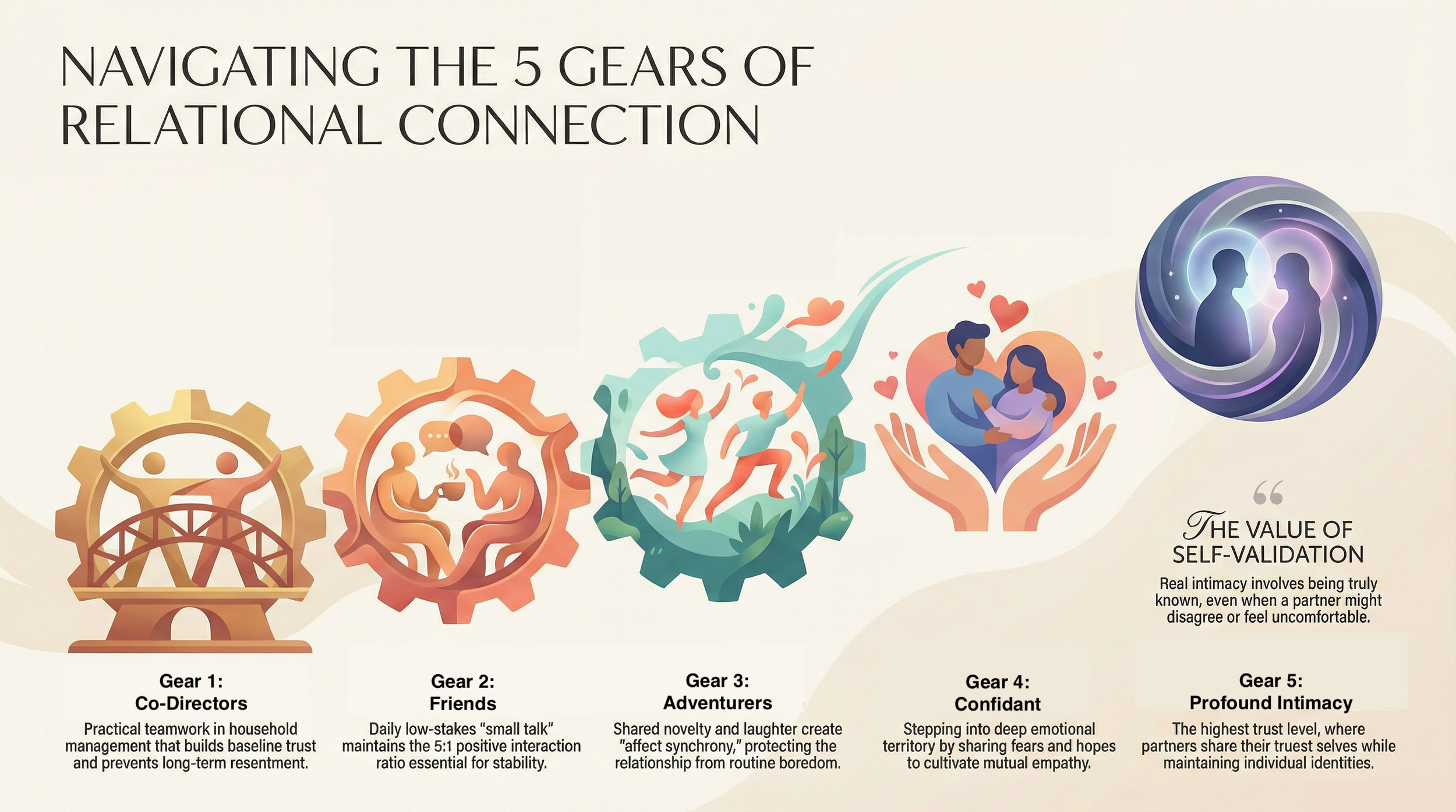
5 Gears of Connection: Enhancing Relational Connection
The five gears of connection explore different layers of relational intimacy. Each one stands on its own as meaningful. At the same time, when a relationship regularly engages multiple gears, emotional resilience and relational intimacy deepen. This in turn can enhance sexual intimacy, moving it beyond sexual activity to intimacy.
Regardless of the “gear”, foundational to intimacy are the principles of honesty, safety, trust, and vulnerability. Without a commitment to these underpinning values, true intimacy can not occur.
The First Gear: Co-Directors
This is the baseline gear required to manage a shared life.
Here, partners function as co-directors of the family firm. It may not feel romantic, but reliably sharing responsibility builds trust through both verbal dialogue about tasks, follow through, and consistent action.
This includes:
Discussing schedules
Dividing household tasks
Managing finances
Parenting decisions
“Life maintenance” conversations
When practical responsibilities are shared, resentment decreases. Emotional safety increases. And interestingly, when stress is reduced, desire often has more space to emerge. In fact, there is an association between shared household responsibilities and higher sexual satisfaction.
The Second Gear: Friends
This is everyday friendship. It is the steady, low-stakes sharing of life:
Debriefing your day
Sending a message just because
Sharing something amusing
Expressing appreciation
Talking about a show you both watch
Sharing about your interests whether shared or separate
This gear may seem small, but it builds warmth, affection, fondness, and admiration. It reinforces the message: I like you. I enjoy you. When this gear is neglected, couples can drift into logistical co-parenting or roommate-style relating. Reintroducing simple companionship often restores ease and safety in the relationship climate.
The Third Gear: Adventurers
Playfulness injects fun, laughter, novelty and humour into a relationship.
It includes:
Trying something new together
Dancing in the kitchen
Banter and teasing
Games and shared adventures
Breaking routine intentionally
Play builds shared joy and reawakens curiosity. It allows partners to see each other with fresh eyes.
In long-term relationships, routine can quietly dull erotic energy. Playfulness disrupts predictability and strengthens attraction. There is an “aliveness” to the relationship.
“Affect synchrony” refers to the subtle emotional alignment that happens when two people are attuned to each other’s facial expressions, tone, body language, and rhythm. In relationships, moments of shared laughter, eye contact, or emotional responsiveness help nervous systems settle together, strengthening connection and reinforcing a sense of safety and belonging.
The Fourth Gear: Confidants
This gear requires courage. It involves sharing your inner world:
Fears
Insecurities
Disappointments
Longings and hopes
Relationship needs
When partners are confidants there is the sense of deep trust, the other person has your back, they will listen to understand, provide empathy, they are in your “corner”. It is a sense of we can journey together through both the challenges and positives of life.
It is a shift from doing things together, talking about things, to being able to share your heart with each other.
This gear cultivates emotional safety. It allows partners to co-regulate stress and respond to each other with empathy rather than defensiveness. Rather than “You never spend time with me,” it becomes, “I feel lonely when we don’t connect.”
For individuals who have historically only expressed vulnerability through sex, learning to verbalise emotional needs can feel unfamiliar. Yet it builds a deeper and more sustainable intimacy.
The Fifth Gear: Profound Intimacy
This is the deepest gear.
It is the ability to be fully yourself with all your desires, values, boundaries, dreams, doubts, and disagreements, while remaining connected.
It includes:
A sense of passion, vitality, excitement towards each other
Sharing a deeply held truth, a sense of shared meaning
Exploring each other’s deepest dreams
Showing up authentically, and giving your partner the space to authentically be themselves
Staying grounded when your partner disagrees
Experiencing moments of profound emotional attunement
This gear is not about merging or losing oneself in the other. It is maintaining a whole sense of self, while connecting with another. When a person remains “whole” in themselves and there is a sense of clearly defined identity, I know where I begin and finish, and I know where you begin and finish, this cultivates a space to be drawn towards the other in passion, curiosity, or desire. When incomplete “halves” merge together and there is a loss of self-identity in the other, this can smother not only sense of self but desire for the other.
It is about authenticity within connection.
When partners know they can reveal their truest selves (strengths AND weaknesses), have the space to be their healthy, authentic self, and still be loved, intimacy becomes expansive rather than fragile.
Think of It Like Driving
Most everyday driving happens in lower gears: steady, responsive, adaptable. If you try to start a car in fifth gear, the engine stalls. If a relationship relies solely on intercourse (or profound emotional moments) to feel connected, it bypasses the foundational gears that sustain closeness.
When practical teamwork, companionship, playfulness, and vulnerability are active, deeper intimacy becomes a natural flow rather than a pressured goal.
At the same time, it is not realistic or sustainable to always find yourself in fifth gear, even when the other gears are functional. You will not always have moments that are “profound” in a relationship.
Connection is not a single destination. It is a dynamic system.
Practical Steps You Can Try
Identify Your Default Gears
Which gears are strongest in your relationship?
Which are underused?
Strengthen the Lower Gears
If you feel emotionally disconnected or sex has become the primary way of feeling close, try intentionally focusing on Gears 2 and 3 for a week. Remove the pressure of escalation.
Expand Your Menu
For each gear, list specific ways you can connect. Perhaps there are things you would like to talk about or share that you have not created the opportunity to. Compare lists. Discuss comfort levels and boundaries.
How Sex & Relationship Therapy Can Help
Many couples enter therapy believing their issue is “low desire” or “not enough sex.” Often, the deeper issue is an imbalance in the gears of connection.
Sex therapy provides space to explore:
How you each experience closeness
Whether sex has become a substitute for emotional expression
What blocks connection (stress, resentment, shame, avoidance)
How to rebuild emotional intimacy alongside physical intimacy
How to reduce pressure-driven patterns
When emotional connection expands, sexual intimacy often becomes more relaxed, responsive, and mutually satisfying.
Final Reflection
Sex is not the only pathway to closeness.
Connection is layered, varied, and adaptable. When couples understand the Five Gears of Connection, they begin to see that intimacy is not about always reaching the highest gear, it is about moving fluidly between them.
Sometimes the most powerful shifts begin not in the bedroom, but in the kitchen, the car ride home, or a moment of honest conversation.
If you feel stuck in one gear, whether emotionally distant or overly reliant on sex to feel close: I offer online sex therapy across Australia. Together, we can explore your unique patterns of connection and help you build a relationship that feels both emotionally grounded and sexually alive.
Written by Justine
