
The 5 Gears of Touch: Building Physical and Sexual Intimacy
In this video I explain the 5 gears of touch and how this enhances your relationship.
If sexual intimacy is a language, physical touch is like the basic alphabet that forms words, that form sentences, that form into poetry and lyrics.
Getting back to basics with physical touch often enhances overall couple intimacy. Often in relationships where misunderstood sexual needs are at play (often termed “mismatched desire” read blog here), and sexual intercourse wanes, other forms of sexual intimacy and physical touch disappear. This leaves a relationship physically and sexually starved. Sexual intercourse may not always be possible due to pain, dysfunction, relational and psychological blocks. However, this does not need to mean that there is no physical or sexual touch whatsoever. Even in relationships which do enjoy sexual intercourse, broadening and varying your repertoire of physical and sexual intimate encounters, without it always leading to sexual intercourse, makes for a more robust and resilient experience of sexual intimacy.
The 5 Gears of Touch
The 5 Gears of Touch explores different types of physical touch and sexual intimacy in a relationship. Each one of these gears is completely valid in and of itself, without it needing to develop into anything else. At the same time, utilising a range of gears does tend to have a flow on effect in enhancing arousal and sexual intimacy.
This model was developed by acclaimed sex therapist Barry McCarthy, in response to a pervasive and unhelpful “intercourse or nothing” mentality.
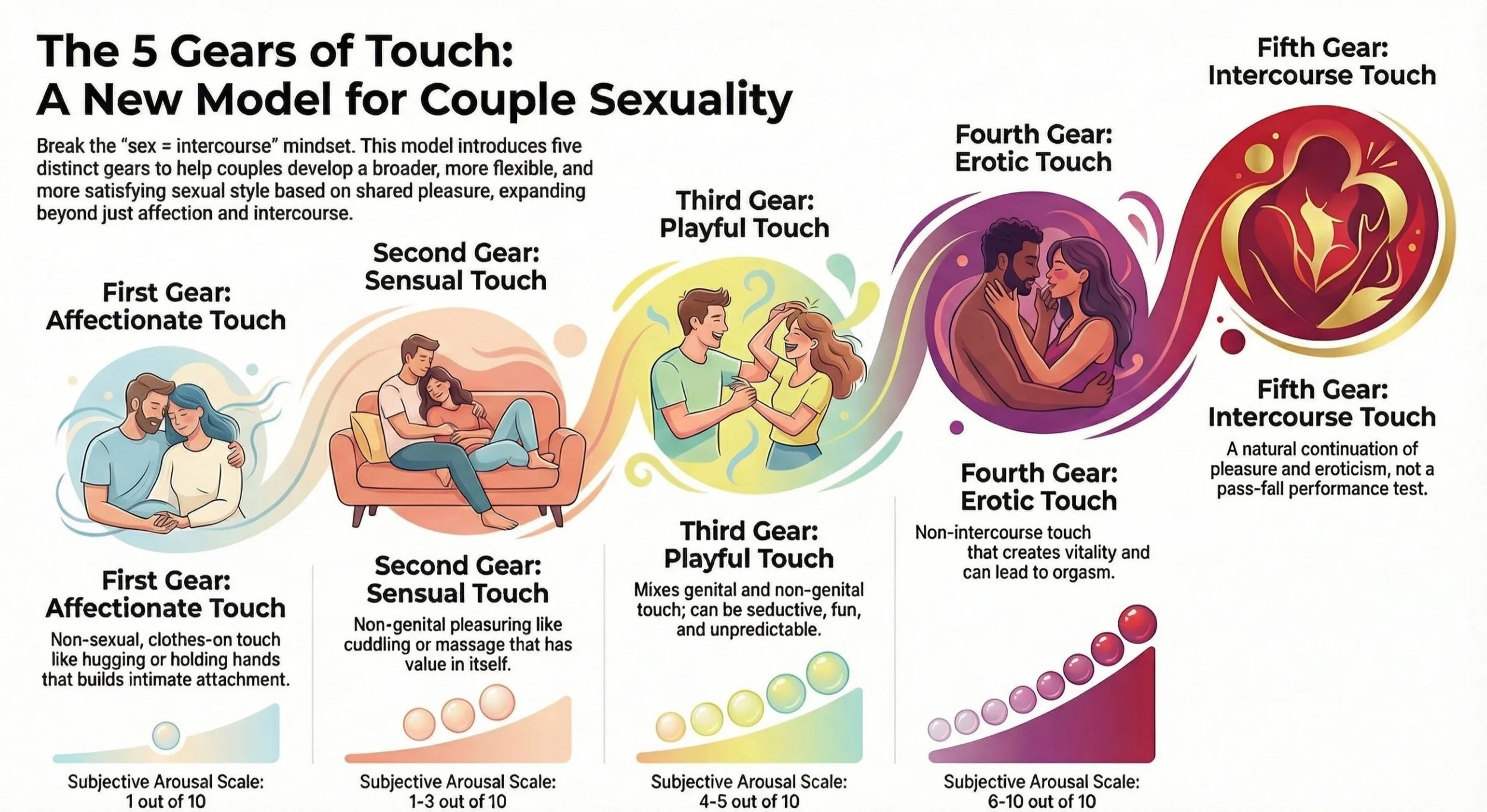
Five Gears of Touch to Enhance Physical and Sexual Intimacy
The first gear: Affectionate touch
This is everyday acts of physical touch such as hand holding, a peck on the cheek, a kiss goodbye, a good morning hug, a comforting squeeze on the arm, and a cuddle on the couch.
The second gear: Sensual touch
This is prolonged, enjoyable touch, with a focus on sensation such as stroking the head/hair, a back rub, a foot massage, spooning in bed, running fingers up and down a neck or arm.
The third gear: Playful touch
This is fun, flirty, light hearted touch which may include genital touching such as a cheeky pat on the bum, a lick on the neck, a nibble of an ear, a 6 second kiss, a squeeze of a breast, a dance in the kitchen. This may involve some laughter. When was the last time you enjoyed the intimacy of laughter in sexual connection?
The fourth gear: Erotic touch
This is where the heat ramps up, sexual desire is in swing, there is a sense of passion, arousal, and wanting. Genital touch is more involved in this stage. This can include making out, full body touching and erotic massage, exploring body parts with the mouth, lying together and rubbing naked in bed, and manual stimulation of the genitals. In fourth gear, arousal may peak to orgasm.
The fifth gear: Intercourse
This is a natural, flow on gear that builds on the previous gears. It is not a pass or fail test, or an all or nothing goal to be achieved. It is not the only valid measure of sexual intimacy. At the same time, intercourse is valid and can be a deeply connected, enjoyable experience for many couples, and more likely so when it is built on a robust foundation of both emotional and physical intimacy. Intercourse can involve penis and vagina penetration, however, this is a reminder that penetration or intercourse also includes oral penetration, finger penetration, or even the use of a vibrator.
Even in fifth gear, other gears of touch can be brought in to enhance this experience, for example times where affectionate touch is brought in such as hand holding, or sensual touch of stroking hair.
It is important to recognise that often when intercourse is missing in a relationship, it may also be because there is a lack of the other gears in the relationship, which tends to reinforce the pressure of intercourse as a goal. This pressure can also be seen when there is a reluctance to engage in the other gears, due to the sense that it is an initiation towards intercourse (goal-oriented/pressure-oriented touch).
Think of the five gears of touch like driving a car.
Most everyday driving on the streets happens in the lower gears: steady, manageable, and responsive to what’s around you. In the same way, affectionate, sensual, and playful touch are meaningful forms of intimacy on their own.
If you try to start a car in fifth gear on the edge of the highway, the engine is likely to stall. Likewise, when sexual intimacy jumps immediately to intercourse, without the build-up of other touch in everyday life, this can create pressure, anxiety, or difficulties with arousal and desire.
A satisfying sexual relationship isn’t about being in the highest gear all the time. It’s about moving smoothly between gears, allowing for different speeds and different types of connection depending on the moment. Enjoying the journey is far more important than how fast you go.
Other times, there may be the presence of other forms of touch, but touch becomes pressured. When touch occurs, there is the pressure or demand that this will lead to intercourse. This is a goal oriented approach to sex. Inherently, intimacy is about connection, not a goal. A goal oriented approach is transactional. It treats physical and sexual activity like a vending machine. If I push the right buttons, you will dispense sexual intercourse. Sometimes this works and I get sexual intercourse, other times it doesn’t (the other person says no or avoids sex due to the pressure). This then means I push those buttons or toggle at those gears with more and more urgency, which leads to more and more pressure, which leads to more withdrawal or duty sex (which generally is not sexy sex), leading to less sexual pleasure, and less sexual desire. This can then mean I give up trying to push those buttons, but can also mean withdrawing from emotional and physical intimacy completely.
When touch has become pressured, and one person withdraws from touch due to the anxiety that comes with this (anxiety is not sexy), it is important to unlink touch from the goal of fifth gear, and relearn touching for the pure joy of connection, pleasure, closeness, and intimacy.
Practical Steps You Can Try Now
Make a Touch Menu.
For each of the gears, come up with all the different types of touch you can think of that you and your partner can share. Compare lists, and of course have a discussion around consent regarding which types of touch you are both comfortable with and in what contexts.Identify Your Default Gears.
Identify what gears you are already using in your relationship. How can this gear be strengthened? What gears have been neglected and how they can be reintroduced?Take Intercourse Off the Table
If sexual intercourse has become a pass/fail intimacy test in the relationship and other physical/sexual touch has been neglected, it is time to go back to the basics and relearn the alphabet. Set aside time (e.g. 15-30 mins) to explore each gear, explicitally taking sexual intercourse off the table to unlearn and weaken the link of goal-oriented, pressured touch. And finally point 4.PLEASURE IS THE MEASURE.
When touching, notice what sensations feel good both in touching and being touched. What pressure, texture, type of touch, temperature do you enjoy? Notice the sensations in your body as you experience this enjoyment. What other sesnses are stimulated: sight, smell, taste, hearing? What parts of your partners body to you find interesting, notice in what way you enjoy touching them, how does their body feel to you? Let curiosity guide connection.Deepen Emotional Intimacy
The Five Gears of Connection is a parallel concept which broadens and deepens how couples connect emotionally, and supports couples to move beyond the belief that sex is the only way to feel close. The more relationally connected you are, the higher the likelihood of sexual connection.
The five gears of connection is a concept I came up with, in response to the five gears of touch framework, drawing upon relevant theory and relationship research.
How Sex Therapy Can Help
Sex therapy provides a safe, supportive space to explore your patterns of physical and sexual intimacy. Many couples find themselves stuck in just one or two gears, or trapped in pressure-driven cycles where touch becomes tense rather than pleasurable. Therapy helps couples slow down, attune to each other, and rebuild the foundations of closeness.
Together we can explore:
How each partner experiences desire, comfort, and connection
What blocks intimacy — stress, resentment, shame, avoidance, fear, or misunderstanding
How to expand your repertoire of touch in ways that feel safe and exciting
How to communicate wants, boundaries, and pleasure clearly and kindly
How to reconnect with sensuality (not just sexuality)
How to rebuild eroticism in relationships impacted by low desire, pain, dysfunction, or relational strain
Sex therapy is about creating a shared space where intimacy can grow in its own time, at a pace that feels right for both partners.
Final Reflection
Touch is one of the most powerful ways couples communicate love, appreciation, and desire. When the 5 gears of touch are understood, valued, and intentionally explored, intimacy becomes more playful, varied, and emotionally connected.
You don’t need to be in crisis to begin this work. Sometimes the most meaningful relationship changes begin simply by slowing down, touching with intention, and rediscovering the pleasure of each other’s bodies.
If you and your partner feel disconnected, unsure where to begin, or caught in patterns of pressure or avoidance, I offer online sex therapy across Australia. Together we can explore your unique patterns of intimacy, strengthen communication, and help you build a more connected and fulfilling sexual relationship.
Written by Justine
